
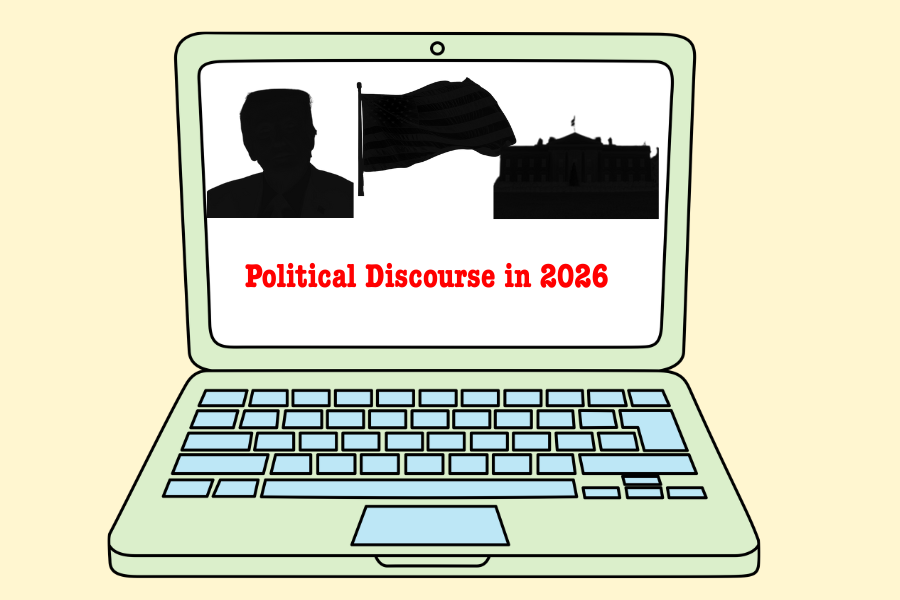
American politics are polarized. In fact, it’s so polarized that it almost seems cliche to call it what it is. Political spheres are plagued with endless arguments about the right way to run the country, while some try their best, albeit ineffectively, to act as voices of reason, reciting catchphrases such as “Why can’t we all agree to disagree?” or “Why can’t we all get along?” These attempts are well-intentioned, but ultimately miss the mark in targeting the root cause of political divisiveness in modern political spheres.
In 2026, the vast majority of the general public get their information from social media. Perhaps some get theirs from newspapers and news channels, but in the modern era, it’s far more convenient to get information from bite-sized clips delivered to you through an algorithm than to sit down and read a full-length news article. Nearly 1 in every 5 Americans get their news from TikTok as a platform alone. In 2020, it was just 3%. This increased amount of major world events being circulated through social media has been, in many ways, a force for good.. Now more than ever, there’s a massive incentive to be politically alert. The social and reputational costs of being politically unaware are damaging. This increased awareness means more people are engaging with political institutions, and more people care about the world around them. However, at the same time, the growing incentive to be socially conscious at all costs has led to people digesting short-form, online content that often bastardizes real issues.
A cursory glance at Instagram, TikTok, or any other platform that displays short-form content reveals exactly the root cause of growing polarization. Countless unqualified creators cosplay as political pundits and oversimplify the most complex societal issues to catchphrases designed to elicit clicks and likes. These creators have an incentive to not provide objective viewpoints, and sensationalize the nature of issues. The more objective and detailed the content, the longer the video. Oftentimes, creators merely take snippets from articles or out-of-context quotes that portray political rivals in an unfavorable light and use their platforms to portray them as an unfiltered view of what the other side of the aisle believes. This short-form, sensationalized content is more appealing than ever in an era where human attention spans are at their lowest ever. The increased amount of people wanting to be politically informed at all costs while simultaneously wanting bite-sized content has ravaged political literacy.
It is simply impossible to learn about political issues in a video that is less than thirty seconds long. Oftentimes, these videos use cherrypicked sources of information to illustrate half-baked points. The result is an uninformed audience that believes they’re knowledgeable about multifaceted social issues. The vast majority of political influencers create short-form content with the aim of getting views, not to educate the masses. That’s why their videos try to stretch the truth as much as possible.
However, the impacts of this faux-informative content stretch far beyond being inaccurate. They create echo chambers that breed polarization. Political discourse is already hard enough, but it’s near impossible when the people arguing are not only trained to demonize the other person’s point of view, but also factually wrong about what they’re saying. Data from 2022 shows that nearly 62% of Republicans and 54% of Democrats had an unfavorable view of the other party. 30 years earlier, the same was true for only 21% of Republicans and 17% of Democrats. In the midst of this rising polarization, it’s more important than ever to be informed. While it’s true that some points of view are irreconcilable with progress and equality, the majority are nuanced, and deserve to be given the time of day. If we don’t, we risk entrenching dogma and divide, halting progress for all communities.
Social media has undoubtedly been transformative for the political sphere. Yet, it’s imperative that we separate the good from the bad. Political short-form content has increased social awareness about current events, but also has a propensity to spread disinformation rampantly. The onus largely falls on us, the consumers of content, to be smarter about where we get out information from. Seeking for unbiased, long-form content sources ensures that the information we get is more detailed, accurate, and has less potential for bias. Though less convenient than short-form content, it’s a small price to pay for a more accurate view of the world.


Ritvij • Feb 3, 2026 at 12:03 pm
W Article Nikhil
Bella Yi • Jan 23, 2026 at 10:47 am
I love this nikhil