


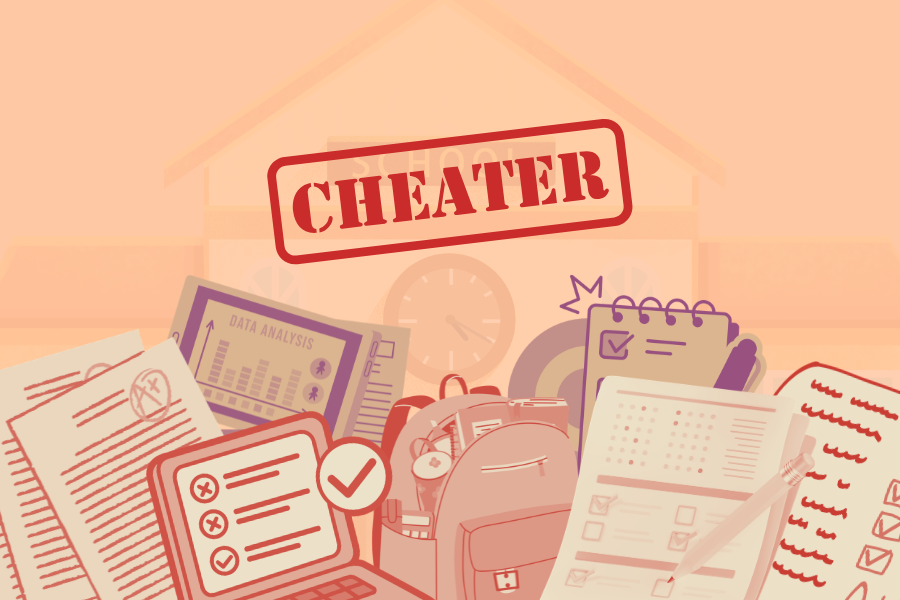
Frantically trying to finish an essay on Macbeth by William Shakespeare, a student opens up ChatGPT as 2 a.m. glares at them from their bedside clock, the LED lights casting a red halo of disapproval onto the unsuspecting student’s face. Out of options, they frantically paste the prompt into the chatbot.
There was an error generating a response.
But the internet is vast, and the next best option lies a few keystrokes away: Gemini. The student pastes the prompt into the digital assistant.
There was a problem generating a response. Please try again later.
Bedtime far in the rearview mirror, the student runs through their bookmarked folder of artificial intelligence (AI) powered chatbots. They know that their work is supposed to be organic, and that usage of AI is unethical, but they also know that without it, there’s no way they can finish the assignment in time. They could take a lower grade, but they know that’s not an option with how cutthroat the college application landscape is becoming. They sigh defeatedly as their screen flashes in rapid succession as Claude, Meta AI, Microsoft Copilot, and DeepSeek all return identical error messages. There is one savior, however: Perplexity AI.
As a last resort, the student copies Perplexity’s analysis, pastes it into the Schoology assignment submission form, and hits submit at 2:10 a.m., the entire process taking only 10 minutes. A day later, an unsuspecting teacher gives the student an A and applauds them for their masterful analysis of the prompt, a clear sign of deep passion for the subject and the effort they put into the class. Unbeknownst to her, this essay is one of hundreds of AI-written essays she’s had to grade all year. This is the state of schooling in the era of AI. This is the culture of academic dishonesty at Westwood.
Three years ago, Horizon Editor-in-Chief Amoli Agarwal ‘23 investigated Westwood’s academic dishonesty issue. Since then, three classes have graduated, the school has implemented a number of anti-cheating policies, and new technologies have revolutionized the way education works — yet we stagnate. Comparing Agarwal’s data to a survey conducted this school year, there is little improvement. In the midst of a changing society, students continue to cheat incessantly, giving new meaning to the proverb “old habits die hard.”
In my sophomore year, the Warrior Code of Honor was instated.
As the Westwood Warrior community, we commit to integrity, dignity, and trust. We hold each other accountable to act with honesty and authenticity. We continuously strive to be our best selves for a better world.
Mandatory videos detailing the code’s commitment and the new Westwood Academic Integrity Matrix, an infographic explaining the different forms of thinking (like independent thought and fact-finding) required for different assignments, were shown during the first week of school. Yet, nothing changed. Master copies of AP math tests continued to circulate group chats and Discord servers, and “gophers” — Westwood-specific slang for test or quiz answers — continued to be given out in the hallways on a daily basis. It was as if the lessons delivered in those videos, our commitment to integrity and honesty, were thrown out the window. We never even tried to be our best selves.
For the past few years, the school administration has made conscious approaches to target cheating, from implementing the code of honor to delivering two-part academic integrity presentations to freshmen. It would be wrong to say they haven’t tried. Westwood is, no doubt, a pioneer when it comes to implementing policies meant to curb cheating; faculty members have presented these efforts at national conferences, receiving positive feedback all around. Yet, though adults are consistently putting in the effort to level the grade playing field, students are not pulling their weight.
According to a survey of 323 students and faculty members, an estimated 54% of the student body cheats, similar to three years ago, when students and faculty estimated 52.5% of the student body cheats. Furthermore, 70% of students and faculty attributed cheating to pressure by college admissions and/or parents, shockingly similar to data from three years ago, which showed that 68% of respondents attributed that external pressure to cheating. However, there were differences too. Perhaps one of the most interesting changes was the amount of students who attributed their cheating to being surrounded by other students who cheated: 60.5% of respondents this year attributed this as the main reason for academic dishonesty, but three years ago, 48% of students and faculty attributed their surroundings to pressure to cheat. This hints at a growing correlation between cheating and peer pressure. The easy way out looks tempting when everyone else succeeds, albeit only in the short-term, with it.
The varied reasons reflected in the results illustrate just how nuanced the issue of cheating at Westwood is. Many are quick to label the act of cheating as immoral, and symptomatic of massive character flaws. While it is true that many of these practices are unethical, discussing academic dishonesty productively requires far more depth than “cheating is dishonesty.” The intense pressure at Westwood, the fight for every decimal point of GPA, the battle for a 100 versus a 99 in AP courses, and the loads of homework every day takes a mental and physical toll on students. In a school where the top 10% cutoff is anywhere from a 95 to a 97 average in all AP and advanced weighted courses, a low A in a class can feel like the end of the world for rank, reflected by how 69% of students and 74% of teachers attribute cheating to pressure from college admissions.
“Ultimately, I have empathy for people who engage in academic dishonesty,” an anonymous student said. “Pressure, ambition, and challenge can all lead to someone abandoning integrity. It’s a difficult situation to be in for anyone involved. School and life are both unfair, so it’s understandable, though not excusable, when people try to make things easier for themselves.”
When asked if they have cheated before, 39.2% of students responded with either “Yes” or “I prefer not to say” — a 40.8% decrease from 2023. In contrast, the increase in students who claimed they have not cheated before skyrocketed by approximately 40%. Of students who have cheated before, only 34.9% said they wouldn’t cheat in the future — a 7% increase from 2023. This could be a result of students cheating less, or, more likely, a shakier definition on what academic dishonesty truly is. Rather than students cheating less, students have become more secretive.
“What would happen if I put ‘Yes’ for academic dishonesty?” an anonymous student said. “I haven’t ever cheated before, but what if I did? Would you look back on this form and give me a referral? Isn’t cheating punishable by referral and a zero? So wouldn’t this be the perfect opportunity to catch students who admit themselves to cheating? Even if I did cheat, I would still put ‘no,’ out of fear for the ‘what if’ scenario that you know my email [address], which isn’t such a far-fetched theory. How can you ask someone if they have cheated or not? Who would admit to that?”
Though certain forms of cheating are obvious and enshrined as academic dishonesty in the Code of Honor, more ambiguous forms of cheating are equally as pervasive. Ambiguous cheating includes smaller forms of academic dishonesty, such as asking whether a certain topic was on the test, subtly pointing at passages of books or notes, and discussions of a test’s difficulty spiraling into something more. These ambiguous forms of cheating lead many to convince themselves that they aren’t doing particularly as bad as “actual” cheaters.
The rising trend of academically honest students, at least according to the graphs, is surprising. The 40.8% decrease in students responding “Yes” or “I prefer not to say” in response to whether they have cheated before is likely not because people are unclear as to what constitutes cheating, but rather because less people are willing to admit to cheating. Despite few students admitting to dishonesty themselves, respondents claimed on average that 54% of students cheated. This data reveals that the cheating epidemic is still going strong, just that students are getting more bold with lying about it.
Yet, despite the paranoia surrounding admitting to cheating, it seems that in reality, cheaters are rarely punished. Nearly 37% of students said they have never seen anyone receive any sort of consequences for cheating. Though this number does seem to indicate most students have seen punishments for cheating, 37% is still far too high. It is a problem for over a third of students to have not witnessed someone receive consequences for cheating at a school where issues with academic dishonesty run rampant. All of this begs the question: are current policies too lenient? Teachers’ responses varied, with some explaining their classroom-specific policies for cheating, which includes assigning zeroes and disciplinary referrals. Though it is true punishments could become harsher, the larger problem with the current punishment system is collecting proof of cheating. With the majority of student cheating, like verbally communicating test answers outside of school, being nonverifiable, amassing evidence backing up claims of cheating is exceedingly difficult.
“If the student is acting with integrity, they’re going to own up to having cheated,” Instructional Technology (IT) Specialist Simone Deitch said. “If not, it’s going to be tough. [Teachers] are going to have to be more [careful] and [scrutinize] students’ work more carefully. I’m hoping that in talking about academic integrity in our matrix, students will [report others] if there’s cheating going on because it hurts them.”
Photos of entire tests, PDFs of answer keys in Google Drives, and group chats dedicated to cheating have always existed, but as the years have passed, these severe instances of cheating have become more well-known. As we throw away our morals like food scraps, the divide between cheaters and non-cheaters becomes deeply polarized, while those who engage in more ambiguous forms of cheating are caught between two worlds. But one thing is clear: possessing full copies of tests and quizzes beforehand demonstrates an ethical and moral failure on the part of the student body.
“What frustrates me the most is the fact that it’s not fair to everyone when somebody’s cheating,” AP Calculus BC and Multivariable Calculus teacher Craig Sullivan said. “[Students who cheat] give themselves an advantage that everyone else doesn’t have. I know it’s a very competitive world of grades and getting the ranking and trying to get into colleges. [So], when I find that somebody’s cheating, it really frustrates me because I know there’s students that are working hard for their results, but they’re doing it the right way.”
However, contrary to popular belief, cheating is not merely an issue of ethics. It has tangible impacts on college admissions. Time and time again, teachers have shown to have an uncanny ability to detect cheaters, even if they lack substantial proof to report them. When higher-level institutions, the same ones that students cheat to get into, investigate college students’ high school track records, startling truths can be revealed. These are the unforeseen consequences of cheating.
“I heard about a teacher who was here at Westwood for many, many years,” Ms. Deitch said. “Three years after a student graduated, the university contacted that teacher and said, ‘Hey, was this student ever a problem with academic dishonesty? We’re having some issues.’ He was a junior at a really highly ranked university, and they were calling a teacher here at Westwood to find out if they were dishonest. It can still have an impact, and I know that if it’s found later, even after you’ve been accepted to a university, that you were cheating or did something egregious with academic dishonesty, the university can rescind your [diploma].”
High school aims to teach students not just knowledge, but life skills. Hence, following the Warrior Code of Honor is imperative. To many, the code of honor is just another statement: and therein lies the problem. This dismissal reflects the normalization of authority and disrespect. Certain students’ blood, sweat, and tears put into studying for a test goes unseen as cheaters receive higher grades, lowering the chance of a curve that would otherwise allow the student to have an adjusted grade reflective of the work they put into the class. Teachers’ struggles planning around cheating and hard work put into the class goes ignored in favor of students cheating rather than learning material.
“Solving academic integrity problems is hard,” an anonymous teacher said. “The tools available are incredibly easy to use, and look more and more like good choices. The more a student is running behind schedule, the more a student is worried about grades. It’s challenging to create a shared understanding that the work is the learning rather than the assignments and any numbers teachers put on them.”
We never see or know what goes on behind-the-scenes. Teachers put in extensive work to plan around cheating: creating multiple versions of assessments, setting up digital monitoring tools, making new seating charts for tests, searching for similar answers among neighboring students, locking down their test master copies. Yet despite the effort put into creating tests, teaching material, and preparing for cheating, we refuse to honor this. Instead, we search for further ways to curtail the current measures, as if we’re criminals itching to skirt the law.
Perhaps the largest reason for trepidation when receiving schedules at the beginning of the year is the class distribution and orange and white days. Panicking to their friends, students worry about having four hard classes on orange days, or having the first block of difficult AP and Advanced classes. In last-ditch efforts, some students aim to switch out of their earlier blocks to later classes of the same course. Consequently, orange and white day test score disparities are evident: cheating occurs between blocks, and as a result, the gap in test scores widens throughout the class cycle.
“[Orange and white day test score differences are] something I pay very close attention to,” Mr. Sullivan said. “Last year when I taught Calculus AB, we would look at [discrepancies] very closely and say, ‘does it seem like anything’s happening here?’ If it was, every once in a while, we’d switch test days [if] it [seemed] like [cheating] was happening or whether the communication was making a difference in this course.”
Pulling all-nighters and studying from 8 a.m. to 3 a.m. the next day, students are forced to match their performance to that of cheaters if they want to survive in the cutthroat academic climate. They have to study harder, fueling anger and resentment. As resentment and resignation builds up, many students may turn to more dishonest ways to study while capable students are bumped down in the rank system.
“[Cheating] really hurts the mentality of every student who [doesn’t] cheat, because we are getting [lower scores] while watching others [who cheat] get 100s,” an anonymous student said. “The school does nothing to prevent it, and [us honest students] then [lose] out on our GPA, class rank, and more just because we are actually trying our best rather than cheating on everything.”
We have tried endlessly to stop cheating. With the way the situation is developing, it is unlikely that cheating will stop on its own. Without direct action from both students and faculty, severe cheating will continue to rise and rise until the members of these so-called cheating rings receive the highest academic honors.
“I’m probably the only person in my friend group who hasn’t really cheated on any sort of assessment,” an anonymous student said. “Other than a few bright kids at the top of our class ranks, everyone who cares enough about their future to consider their GPA but doesn’t want to study and [doesn’t] have innate knowledge are definitely accustomed to cheating. This is a consequence of the brutal atmosphere at Westwood, which pushes everyone, especially in 11th and 12th grades, to have high grades by any means possible.”
Many classes accommodate to the Warrior academic atmosphere, assessing knowledge in a way that isn’t solely answer-based, such as grading the work and steps shown, and creating assessments that aren’t ChatGPT-able. Nearly every teacher makes multiple versions of tests. However, these incremental, localized changes aren’t enough. There’s a need for a major overhaul of how we deal with cases of academic dishonesty at the highest level. This brutal atmosphere requires quick and authoritative responses. We must take cheating reports extremely seriously, especially because they’re often based in truth. Teachers already know which students cheat, so it’s necessary for us to create mechanisms to obtain concrete evidence of dishonesty.
“It’s very apparent who knows what they’re doing and who doesn’t,” Mr. Sullivan said. “What really makes me laugh is students think[ing] they get away with [cheating] just because we can’t officially prove it. Teachers know who’s [cheating], and it’s really a big hit to their reputation. We may not say anything, but [we] know who’s doing it, and sometimes we’re just waiting for the moment that we actually are able to prove that they are.”
As students, it is our responsibility to strive to be our best. To those who scoff at the notion of being ethical in such a cutthroat environment: how can you celebrate reaching your zenith when you didn’t walk up the path yourself? With students’ typically expansive knowledge of their grade’s cheating landscape, it is imperative that we speak out against incidences of dishonesty. Denormalize cheating and publicly condemn dishonesty. Quietly reporting cheaters with proof can be far more effective than simply constantly complaining about academic dishonesty. We need a student-centered solution to combat academic dishonesty.
Everyone deserves a level playing field; one person should not be given an advantage over the other because ultimately, difficult classes, heavy courseloads, and time-intensive extracurricular activities are a student’s choice. We, as students, need to reassess our behavior. We’re making the lives of fellow students and adults alike a thousand times harder, demeaning our school’s reputation. In the face of the academic matrix and code of honor, upholding academic honesty and denormalizing cheating through reports is paramount. Our generation of youth is always striving for change, in and out of academia. It shouldn’t be any different for academic dishonesty. Old habits don’t need to die hard. It is time to take the first step to shifting the culture.





l • Apr 7, 2026 at 9:11 pm
Omg great article Vee! Though I feel like I knew a lot of this going into the article (simply by being a #westwoodwarrior), this put into perspective what I can be doing to bring an end to this! I ten billion percent feel like cheating is not condemned enough, as it’s sort of shrugged off as a fact of Westwood life rather than being recognized as a problem that should seriously be reckoned with. Like another commenter said, a lot of it does in fact stem from the idea that college is everything. I try to tell my friends that college admissions should be a Product of their success and not the goal, but even I find myself falling into the pits of Rank Demon Despair and Stresswood culture. It’s upsetting for sure, but this article reminded me that we as Youth have power to bring changes we want to see! Thanks Vee! :)))
tz • Apr 6, 2026 at 1:02 pm
I think the obvious solution (for the school) would be dialing back the workload for students, and have actual effective teachers/lessons. Cheaters, like mentioned, are the ones wanting perfect GPAs. And of course, they wouldn’t cheat if it wasn’t like that.
I think cheaters who don’t care about school are a minority, but they definitely exist (Ms. Kantawala mentioned how people tried to cheat in an open note quiz… in Forensics… an optional elective… and one of the easiest classes here IMO) I think those people are just done for, and will cheat no matter what. But for the majority, they’re the ones who want to succeed, and feel cheating is necessary. Interesting how teacher’s opinion raised on “they don’t care”/the more cynical reasons, but lowered on “wwhs is too difficult, teachers are unfair”. Can’t lie, as a personal opinion, I feel like I learnt nothing useful from most of my classes here. The few teachers I enjoyed, I definitely learnt a lot from, beyond from classwork.
Notably, I hear my friends say wish they could’ve gone to a diff school because of the stress culture here. I think stuff like making multiple tests, monitoring chromebooks, and more, only puts a bandaid on a leaking pipe. You gotta fix the pipe itself. Cheaters will always find a work around.
Good article Vee, as always!
Isaac • Apr 6, 2026 at 12:27 pm
Great article! Something to note:
“All of this begs the question: are current policies too lenient?”
You mean to say “raises the question”, as “begging the question” refers to circular reasoning and a logical fallacy.
Additionally, I wonder what the response would be from a freshman, who’s shown the Westwood Code of Honor from day one, and a junior/senior who has experienced the whole process. Do seniors have a more pessimistic view than freshmen, or are they optimistic and seeing a general change in cheating at Westwood?
Mitchell Cone • Apr 6, 2026 at 12:27 pm
Of course there hasn’t been any progress in the past three years because we haven’t (and the school itself really can’t) addressed the root cause of the issue. Coming up with new slogans and posters does nothing, trying to stop cheating preemptively with AI detectors or people reporting it is tantamount to whack-a-mole, and current punishments aren’t going to deter people when the reward is too great. Parents need to realize that their kids’ lives aren’t over if they don’t get into Ivy League schools. There are plenty of state schools (like where I’m going) that offer a great education without forcing you to sacrifice your integrity, suffer a nervous breakdown, or go into six-figure debt.