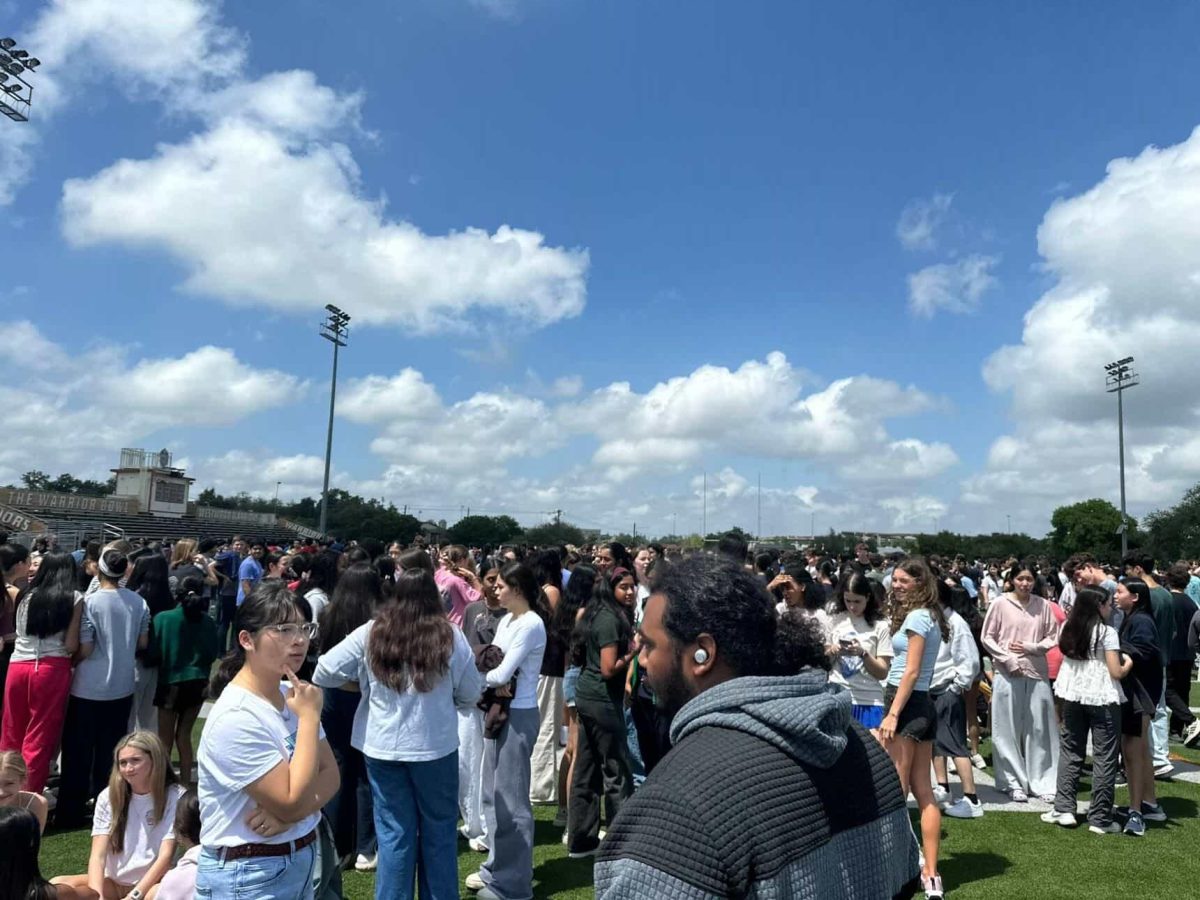
The Public Address (PA) system crackled to life as Principal Erin Campbell directed students to evacuate to the Warrior Bowl at around 2:08 p.m. on Wednesday, April 22, due to a bomb threat that the campus received in the early afternoon.
Administration notified the fire department and police, and for approximately 35 minutes, law enforcement officials conducted a thorough sweep of the buildings. Officials determined that the threat was part of a larger series of swatting incidents — the false reporting of an emergency to a targeted victim’s address — affecting several school districts. The intent of swatting is to cause large-scale deployment of Special Weapons and Tactics (SWAT) teams, bomb squads, and other police resources, often leading to confusion and frustration.
“At no time were our students or staff in any danger,” Ms. Campbell said in a campus safety letter. “We appreciate the calm way our students and staff handled the disruption, and we are thankful for the quick responses from police and firefighters.”
Later that day, San Marcos Central ISD said San Marcos High School in San Marcos, Texas, was temporarily placed on hold by police following a report to 911 that someone had a gun at the high school. City officials said this threat was “unfounded” and believe it was part of the series of swatting calls.
“I definitely know that in these situations, you don’t want to panic,” math teacher James Cox said. “Even if you do feel nervous, you can’t show it because you are a role model, so I knew I had to be calm, and composed, and I mostly was, because I know statistically that when we evacuated, it’s most likely going to be fine. I tried to stay composed, professional, [and] had everyone escorted.”
As the entire student body and faculty congregated in the Warrior Bowl across the street, the crowded atmosphere and temperature hovering around 82 degrees Fahrenheit contributed to the initial confusion regarding the reason behind evacuation.
“We were doing a Supreme Court case study in my government class and they came over the announcements,” Ella Braun ‘27 said. “We don’t usually evacuate to the Warrior Bowl, so I guess we all knew something was happening. Luckily, I had my phone on me, but otherwise, I’m not super anxious about it. I know they’ve got it under control, and I feel somewhat safe, but I am also worried because all my stuff is inside and I’d like to go back to class.”
Due to the evacuation, students missed the second half of third block and the first 10 minutes of fourth block. With Advanced Placement (AP) and International Baccalaureate (IB) exams starting in two weeks, many students in higher-level courses were interrupted by the alarm during unit tests and AP mock exams. As the alarm sounded, the Texas Success Initiative (TSI) assessment, a state-mandated placement exam for incoming Texas public college students, was also being conducted in the school.
“When we were evacuating the building, I was in the middle of my AP Chemistry test,” Ohm Shankar ‘27 said. “We were a little bit surprised to hear the announcement. We just left immediately and then we went outside. I did feel a bit anxious because I wasn’t sure what was going to happen to the test. Me and my friend were talking about [how] maybe she’ll reschedule the test. We knew that there would be some plan eventually to figure out how to deal with the test, so it wasn’t too bad.”
Since the drill affected testing, teachers conducting quizzes and assessments had to alter their testing plans, from rescheduling tests to curving on a greater scale, to accommodate lost time.
“Third block is my AP Chemistry class, [and my students] were doing an AP mock exam,” AP Chemistry teacher Natalie Wieland said. “They had about 35 minutes left. When [the PA system] came on, [it was kind of a] bummer, but safety first. Everyone was calm, no one was panicking, but now I need to reschedule the test. [The test they just took] is invalid [and] it doesn’t count for them. They’ll have to take a different one [because] that’s the only way to keep it fair.”
Though everyone in the building was safe, receiving a life-threatening message can affect the mental health of students and faculty. Ultimately, the threat prompted discussion regarding the importance of managing feelings of anxiety in unsafe school situations.
“Unfortunately, bomb threats happen,” Mr. Cox said. “It’s definitely important to [address] the feelings involved. Even reentering the building, I can’t help but be a little nervous. It’s probably nothing statistically, but you never know.”