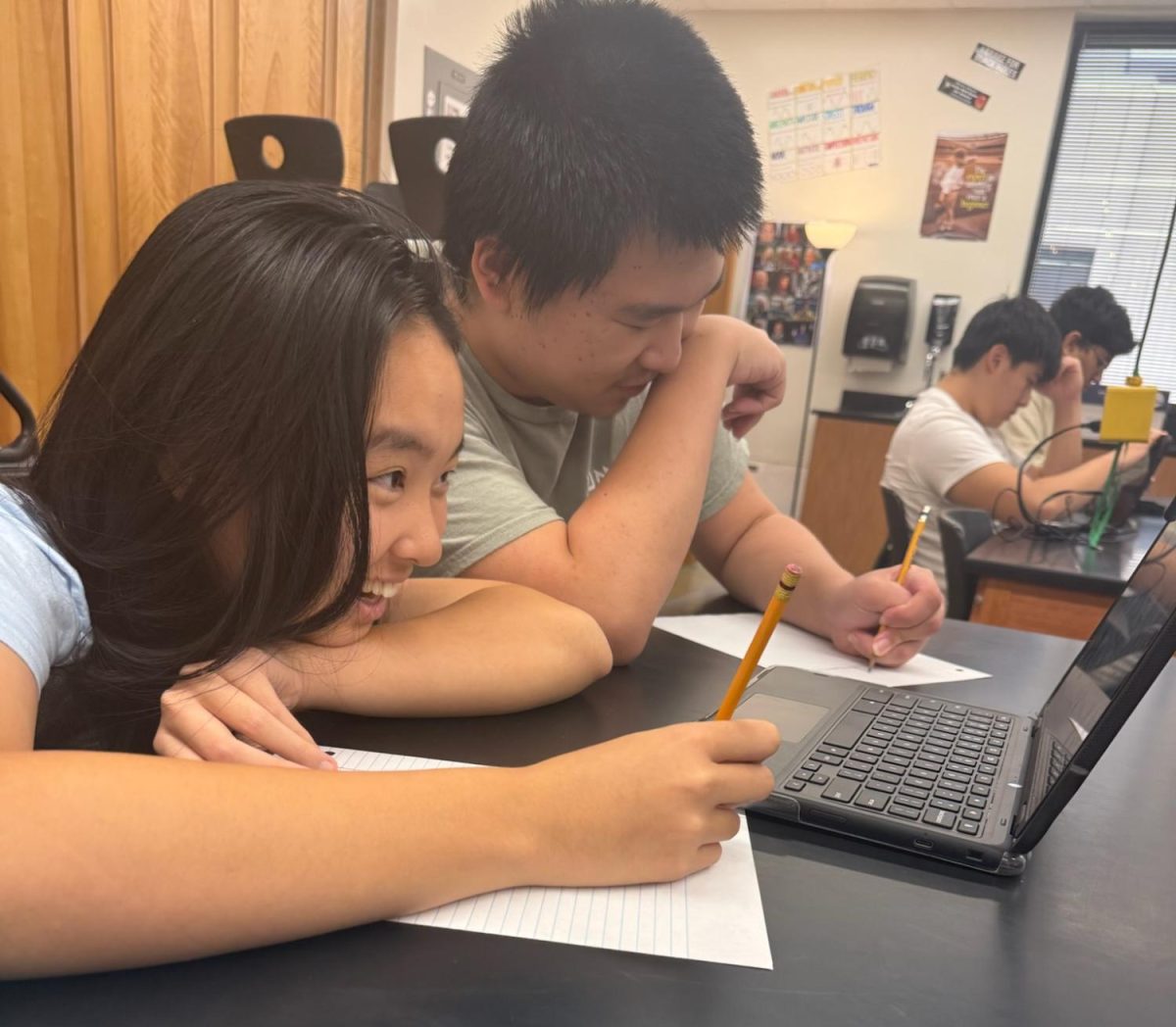

Late at night, the glow of a laptop screen illuminates a student’s anxious face. Fingers hover over the keyboard as they plug hypothetical numbers into the GPA calculator for the 10th time in an hour. Once, earning an A felt like a victory — a simple celebration of hard work. Now, a 96 feels like a failure and glaring reminder that perfection slipped just out of reach.
The obsession with grades underlies a high stakes game of rankings, where every one-hundredth of a point can make or break your standing. This is Westwood’s world of ‘GPA maxing’, where the pressure to stack the hardest courses, chase flawless grades, and achieve the top spot starts as early as freshman year.
“[There is a lot of academic pressure at Westwood] because your GPA matters the most your freshman year,” Isaac Zhang ‘29 said. “You want to have the highest rank possible because it’s very hard to go up in the rankings instead of just starting very high.”
Building the perfect college application stems from class selection. Underclassmen utilize connections and prior knowledge to craft the ideal schedule that guarantees course rigor, easy-grading teachers, and preeminent transcripts.
“[Upperclassmen] can tell me exactly what I should be doing [and] especially teachers I should be avoiding because certain classes and teachers can definitely hurt your GPA,” Zhang said. “The point is that GPA maxing is very important here. It’s a lot about balancing, so having a good core schedule while also maintaining your grade [and] choosing classes that you know you can do and are prepared for.”
The pressure to max out GPA at any costs has become a defining mindset for many students looking to rise in ranking. This obsession over every point can fuel anxiety and insecurity, with the constant stress chipping away at mental health and self-worth. What should be a measure of learning has turned into a source of overwhelming pressure and doubt, prioritizing test scores over genuine learning.
“Overexaggerating [rank and grades] is very common because we don’t want to feel like we’re falling behind,” Diya Shakkottai ‘27 said. “People get depressed, anxious, [and there’s] a lot of worry because we’re focusing purely on numerical performance and fixating on these small things instead of the grand idea of learning.”
Even when schools like Westwood don’t rank students officially, students ranked in the top 10% will have their spot appear on their transcript in compliance with Texas’s automatic college admission policy. This increases the burden of every decimal point, as students strive to be as close to the top as possible, even if already in the top 10% of their grade. The academic competition of rank fosters a culture built on gatekeeping, where some students closely guard grades, rank, and even class resources to climb the ranks. This secrecy means top-ranked students often avoid openly discussing their standing, creating an unspoken divide that fuels competition rather than collaboration and destroying learning in the process.
“Even though Westwood calls itself a nonranking school, I feel this pressure to always compete, like every other kid is competition,” Aarya Patel ‘28 said. “It creates this environment where we’re all just competing against each other rather than actually trying to make friends and be nice. That trumps everything else, especially in social relations, because whenever people are talking to each other, they’re always trying to be like, ‘Hey, what’d you get on this test?’ rather than actually connecting.”
The endless drive to outperform peers and secure a coveted spot at the top of the class creates an environment where, for many students, academic achievement becomes the sole focus. This unyielding pressure to excel tends to not only heighten stress, but also diminish the opportunity to engage meaningfully with the curriculum and educational experience.
“There’s this pressure to always be in the top 10% and to be the highest rank and to do the best that you can to get into a good college,” Patel said. “That pressure has really affected me, especially this year, because I’ve just been thinking about grades so much that I haven’t had as much time to actually enjoy high school and my classes.”
The looming fear of falling behind in GPA and class rank also prevents students from pursuing certain classes solely because they are weighted less than an advanced or Advanced Placement (AP) course. As a result, students are less inclined to take elective courses directly pertaining to their hobbies and interests, such as fine arts or double-blocked sport classes.
“A lot of the times, [Westwood’s toxic culture] restricts us from taking the classes we really want to in order to explore the directions we need,” Shakkottai said. “Whatever we really want to do, we just want to know what we are in comparison to other people and wondering if we’re meeting everyone else’s expectations.”
While the competition and stress surrounding GPA is evident, the deeper consequence of this culture lies in how it reshapes the purpose of education: the emphasis on numerical perfection shifts students’ focus from truly understanding material to simply earning the highest grade possible.
“Taking too many advanced classes is definitely a genuine concern at Westwood,” Shakkottai said. “Especially because we’re encouraged by this toxic culture to stockpile AP and advanced classes so our GPA will go up.”
As the percentile requirement for automatic admission to postsecondary education opportunities continues to burden students, the culture of defining success by GPA and triple digit grades will further dominate Westwood, replacing genuine learning and growing with perfectionism. When countering this mindset, students shift their focus from chasing scores to valuing the learning process itself, embracing mistakes as a part of growth rather than something to avoid.
“There’s an overfixation of always chasing the highest grade or doing whatever you can to appear more successful even though maybe that’s not really the best course of action,” Blair Qiao ‘26 said. “A lot of people think grades are everything, the end-all-be-all, but I don’t think that’s a very good mindset to have. You should make mistakes and learn from the course rather than just asking others for help immediately and getting that 100 in the end, but not earning as much.”