

Known as the location of the National Aeronautics and Space Administration (NASA Johnson Space Center) and a monotonous ‘car city’, Houston, Texas welcomed tens of thousands of For Inspiration and Recognition of Science and Technology (FIRST) Tech Challenge (FTC) and FIRST Robotics Competition (FRC) students decked out in pins, blow-up costumes, and hats arriving in the area. Robotics teams from around the world traveled to Houston for the international 2026 FIRST (Worlds) Championship, an event that ran from Wednesday, April 29, to Saturday, May 2.
The FIRST Championship is the highest competition a Robotics team can qualify for, acting as a culmination of teams’ journeys through the season. Students strive to win awards and showcase their highest robot performance to rank high among the world’s most accomplished teams.
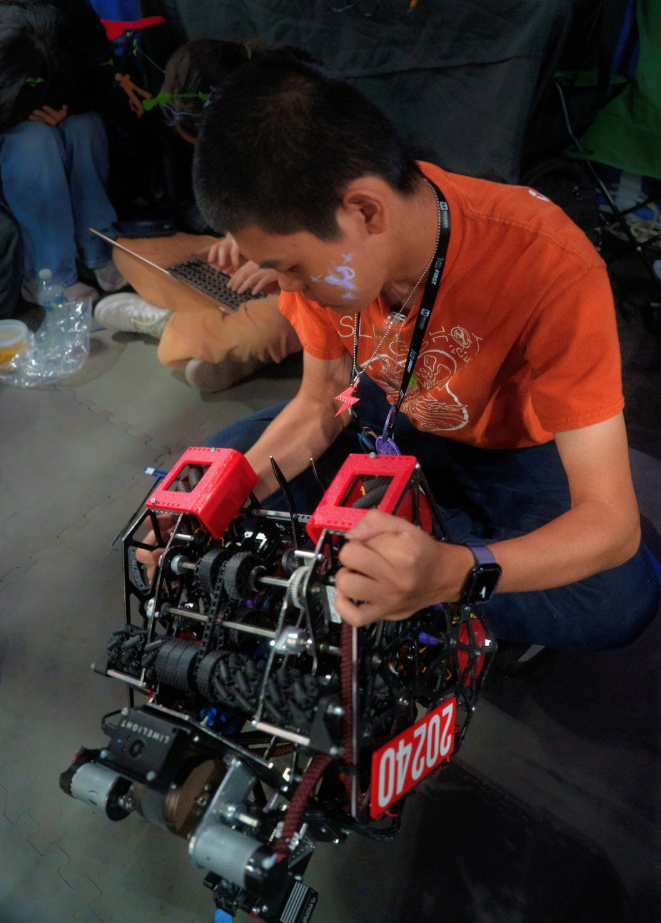
After finishing one ranking point away from qualifying for the Worlds Championship, FTC Team Slingshot had begun to close the chapter on their season with team dinners, final celebrations, and heartfelt messages to graduating teammates. However, Slingshot members were in for a surprise: the last advancing team above them had opted out of the opportunity, giving them the possibility to attend with only six days left before the prestigious competition.
“I felt incredibly happy [when I found out],” Autonomous Lead Ishaan Desai ‘29 said. “We met as a team together right after school and that [increased] the feeling of success even more as we were all celebrating together.”
Rising to the occasion, Slingshot members scrambled to prepare for the very event they’d been recently mourning. With their robot disassembled, the hardware subteam worked tirelessly to rebuild what they had left, turning a skeleton of pieces into a functioning robot.
“Unlike most teams, we didn’t have two months to prepare. We only had five days,” Desai said. “So we designed, created, made and programmed a new robot in five days, which was a huge accomplishment. [Still], that definitely caused our biggest challenges later on because a large amount of our hardware was rushed.”
Due to the immense 336 competing teams, the competition was stretched across three days. With a jam-packed schedule from day one, teams hustled to the George R. Brown Convention Center to set up their pits (team-specific areas at competition decorated to advertise teams’ journeys with portfolios, banners, and tents) and get early access to practice fields for the robot. FTC teams represented their country with flags from Brazil, Korea, Romania, and more.
“Walking around pits was [an incredible experience],” Hardware Lead Arhaan Jafri ‘27 said. “You’d go up to a team from some completely different part of the world and you’re just talking about the same thing you’ve been obsessing over all season. Seeing how a team from another country approached the exact same challenge in a way you never would’ve thought of [is the experience I’m going to miss the most.]”
After waiting through long safety checkpoints and holdbacks, Slingshot’s driver subteam ran to their qualification matches (the first round of competition). Despite effective driving and game strategy, members quickly found that the robot was facing issues since they had built the robot under a tight deadline. Slingshot programming and hardware members mobbed the robot as it came off the playing field, hoping to fix the problem before they suffered additional losses in the rest of the day’s matches.
“Honestly, we didn’t really go in[to the competition] with big expectations,” Jafri said. “When you’ve had five days to prepare, you can’t afford to, but considering what we were working with, the robot actually held up in ways I didn’t expect. There were moments where I was genuinely surprised by what we pulled off.”
While the programming and hardware members scrambled to repair their robot, members on the presentation subteam stayed glued to their pit as judges began making their rounds in the venue. Presentation members trained all year to best adapt their team’s experience to judging criteria. However, as their first judging panel walked up to their pit, they were surprised by an unexpected question.
“We’d thought that [unlike previous competitions,] presentations weren’t needed anymore for Worlds, just back and forth Q&A,” Rupal Jain ‘27 said. “So when our first panel of judges asked us for a quick presentation, all of us froze for a second. Even worse, some of our presentation members weren’t even available at the time because of [International Baccalaureate] tests [happening] throughout the competition, but we really locked in to present the team the best we could off the top of our heads. It was crazy, but apparently it worked, because [judges] kept coming back.”
After the first day, robot-focused and presentation subteam members had a stronger grasp on the competition’s expectations. Slingshot’s performance improved drastically upon fixing the robot’s anomalies — an encouraging prospect for the driver subteam. Presentation members remained on edge as panel after panel came to visit them, increasing hopes for a coveted award.
“We got four judging panels on the second day alone,” FTC Director Aubrey Tipps ‘26 said. “I was just amazed that I got to have this opportunity to be with my favorite people and also be doing well in awards at Worlds, which is super hard to do because we’re surrounded with the best teams.”
Despite not being selected to compete in their division’s finals, the team was awarded the Sustain Third Place award for their sustainability and effective planning. Members gathered to watch the top teams battle for the winning spot, cheering on their peers and new friends. No matter the outcome, all felt it was a trip they would never forget.
“Watching the finals with my team was the most [unforgettable] moment for me,” Tipps said. “So many of these people have become like family to me, so it was such a gift to laugh and enjoy the hype and music all together one last time. Especially since I’m graduating, that’ll be my last robotics moment with these people I love, and I’ll definitely miss it the most.”
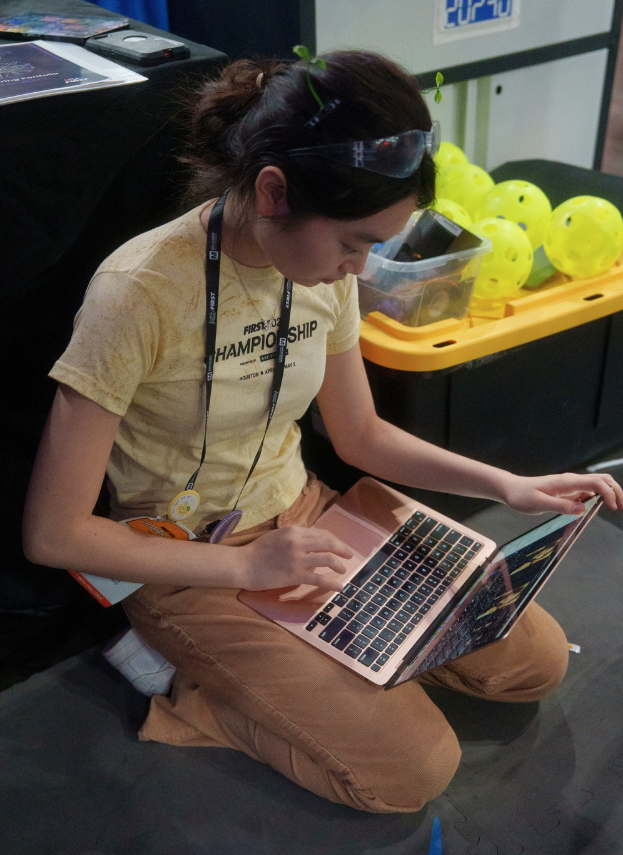

The bus buzzed with energy as FRC Team Orange Dynamite headed to the George R. Brown Convention Center to compete in their final competition of the season against teams from around the world. As Orange Dynamite’s first year qualifying since 2018, the competition was a token for all the hard work that the team put into the season, with the team ending the championship ranked 55 out of 75 other teams.
For the 2026 season REBUILT, FRC teams built robots to collect lightweight foam balls known as fuel and score them into field goals in alliances of three teams. To shoot the balls, robots were required to navigate under a trench or over a raised bump. Orange Dynamite built two versions of their robot over the season, constantly redesigning mechanisms and improving consistency to compete at a high level.
“This is the first time Orange Dynamite has made a world championship level robot, and we saw that reflected on the field this season,” FRC Director Archit Garg ‘26 said. “I’m really proud of the work that everyone did going into the competition, and I think our success on the field this year was a reward to all the members for the amount of time they put into robotics.”
Competing against over 600 other teams, Orange Dynamite members spent four days balancing scouting, alliance strategy, and fast-paced matches. Among the strongest teams in the world, the team used each match as an opportunity to refine their performance on the field.
“I think the most incredible part of the whole experience was seeing all of the other teams, speaking to people from other countries, and hearing all the knowledge from world renowned teams,” FRC Director Shrika Prakash ‘26 said. “It meant a lot to us all to be able to talk to teams we knew of and hear how they saw us, and walking around the pits was so surreal.”
Teams set up pits to showcase their respective cultures. Walking through the pit area, Orange Dynamite members were exposed to a wide range of traditions and engineering approaches, giving members an opportunity to connect with students from around the world.
“One of the most incredible parts of the entire experience was seeing how much impact all of us have made together as a part of this giant robotics community and how much further we can go,” Orange Dynamite member Reett Aulakh ‘28 said. “It was a lot of fun to meet with new teams and meet people who speak different languages and have different cultures, try their foods, collect their merchandise, and get a more holistic view of the world as everyone is in one place. You’re able to make so many global connections, which is really amazing.”
The team spent their first day of competition at practice matches to gauge the performance and reliability of their robot. While their robot demonstrated strong potential in the Autonomous period, mechanical issues with the intake system prevented Orange Dynamite’s design from reaching its zenith of performance. Despite the setbacks, the day served as an important learning experience and helped the team identify key areas for improvement.
“On the first day, we could definitely see the potential of our robot,” Westwood Robotics Event Director Varun Sanghavi ‘27 said. “We would do really well in auto, but then our intake kept breaking so we didn’t really hit our full potential.
By the third day — the second day of qualification matches — the team made adjustments and returned to the field with improved consistency and confidence. On Saturday, May 2, the team created the eighth seed alliance with teams 2767 Stryke Force, 2539 Krypton Cougars and 103 Cybersonics to compete in the double-elimination tournament.
“During the playoffs, we ended up losing our first match, which was expected,” Sanghavi said. “However, we had hopes of winning our second match, which made it really disappointing when we were subbed out by our alliance captain team and got eliminated.”
This substitution marked a difficult end to Orange Dynamite’s time on the field as it brought their season to a close sooner than the team had hoped after months of preparation. Despite their early exit, the experience of competing in playoffs along high-caliber teams reinforced the scale and intensity of the competition. For seniors, the championship acted as a final goodbye to Westwood Robotics and the FIRST community.
“I’ve spent six years in FIRST, and I’ve spent so many hours doing FIRST during high school, so there’s definitely some sadness now that it’s over,” Garg said. “But I’ve had a lot of good success in FTC by making it to Worlds and winning twice, and success in FRC as well. We were a struggling FRC team when I joined four years ago, and looking at us now makes me feel proud of our team and also my impact within FIRST.”
Looking into the next season, underclassmen team members plan to continue Orange Dynamite’s streak and make a larger impact on the international stage.
“Next season, I’m looking forward to developing our team’s efforts further and helping us win awards to bring our team to a higher level,” Aulakh said. “I believe we can easily make a larger global impact, get to Worlds again next year, and make even more global connections to really see how far we can go.”
Now, more than ever, the education of young journalists with integrity is critical to our democracy. Westwood Student Press works hard to bring you award-winning coverage of our school and community. Please consider showing your support for the student journalists of Westwood High School by making a donation in any amount. Your contribution will allow us to purchase equipment and cover our annual website hosting costs.