-
Readying the plastic pink doll, Aysenur Musta ’27 and Simmi Pesnani ’26 readjust the rubber bands after reeling the Barbie back up. The AP Statistics students had to run multiple trials to secure the most accurate results, but also took a moment to have fun in the process.

-
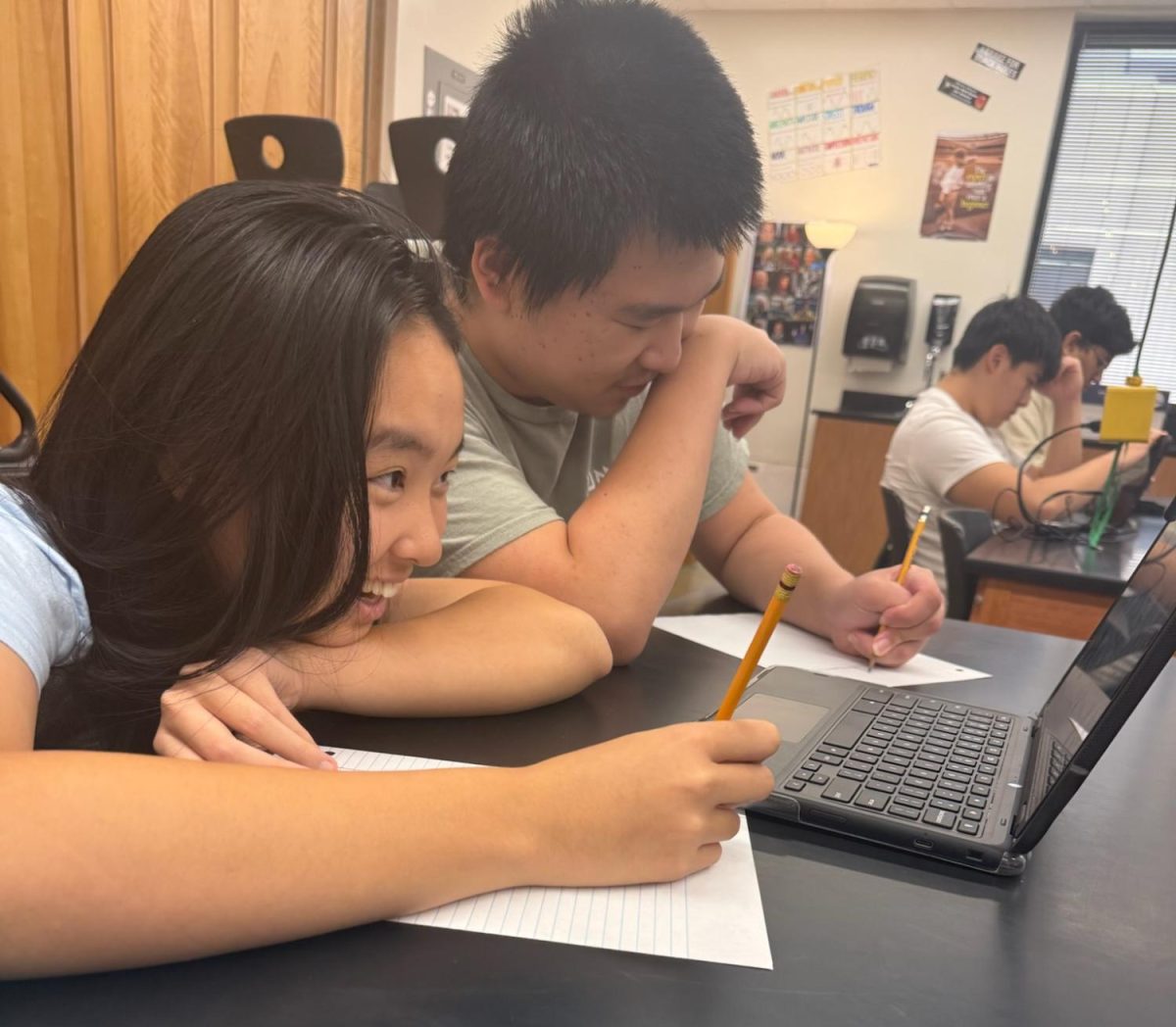
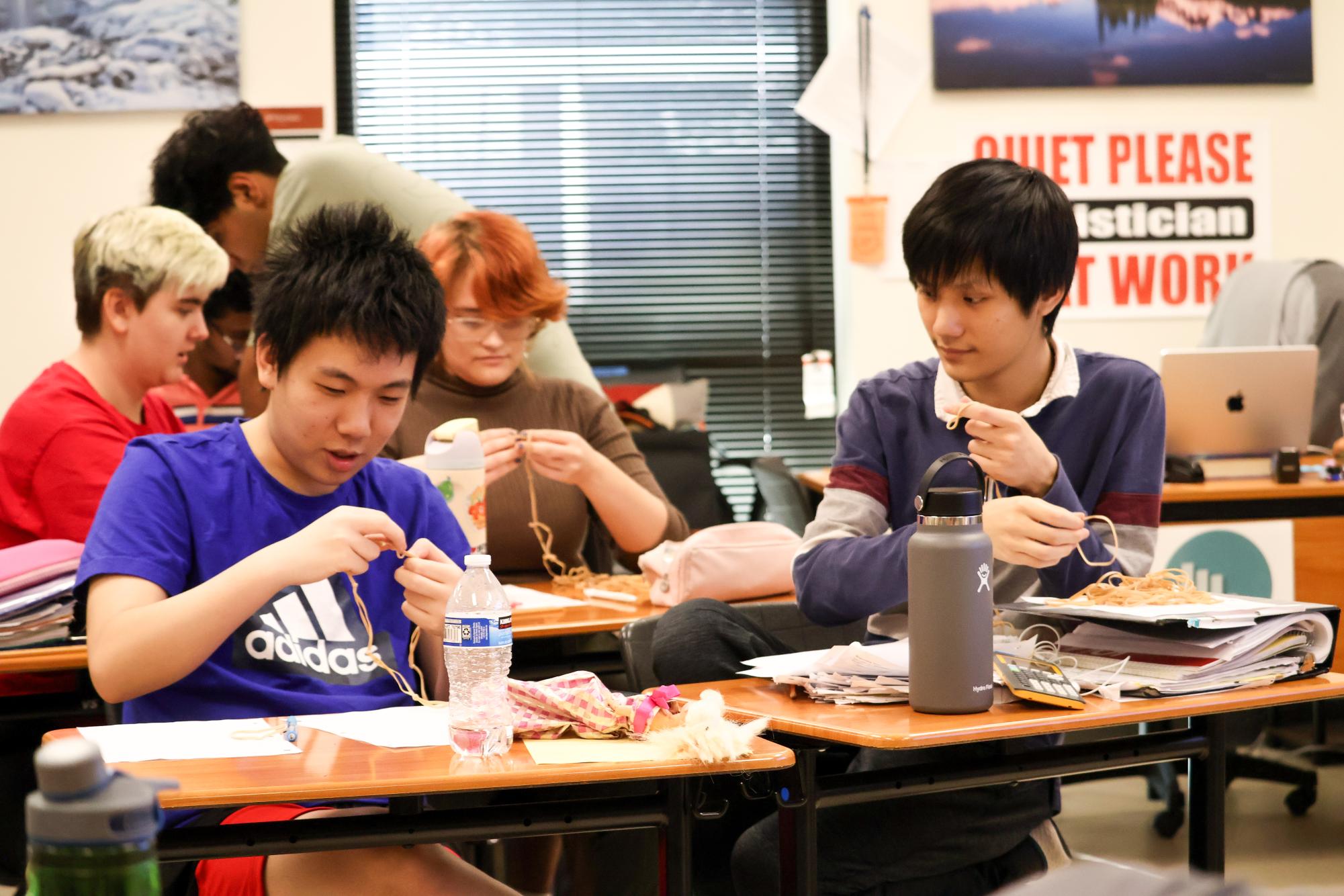
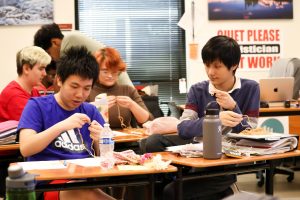
Focused, seniors Justin Yu and David You work together to create a rubber band chain. These chains were essential since the number of rubber bands used would have a significant impact on how far the Barbie doll dropped.
-
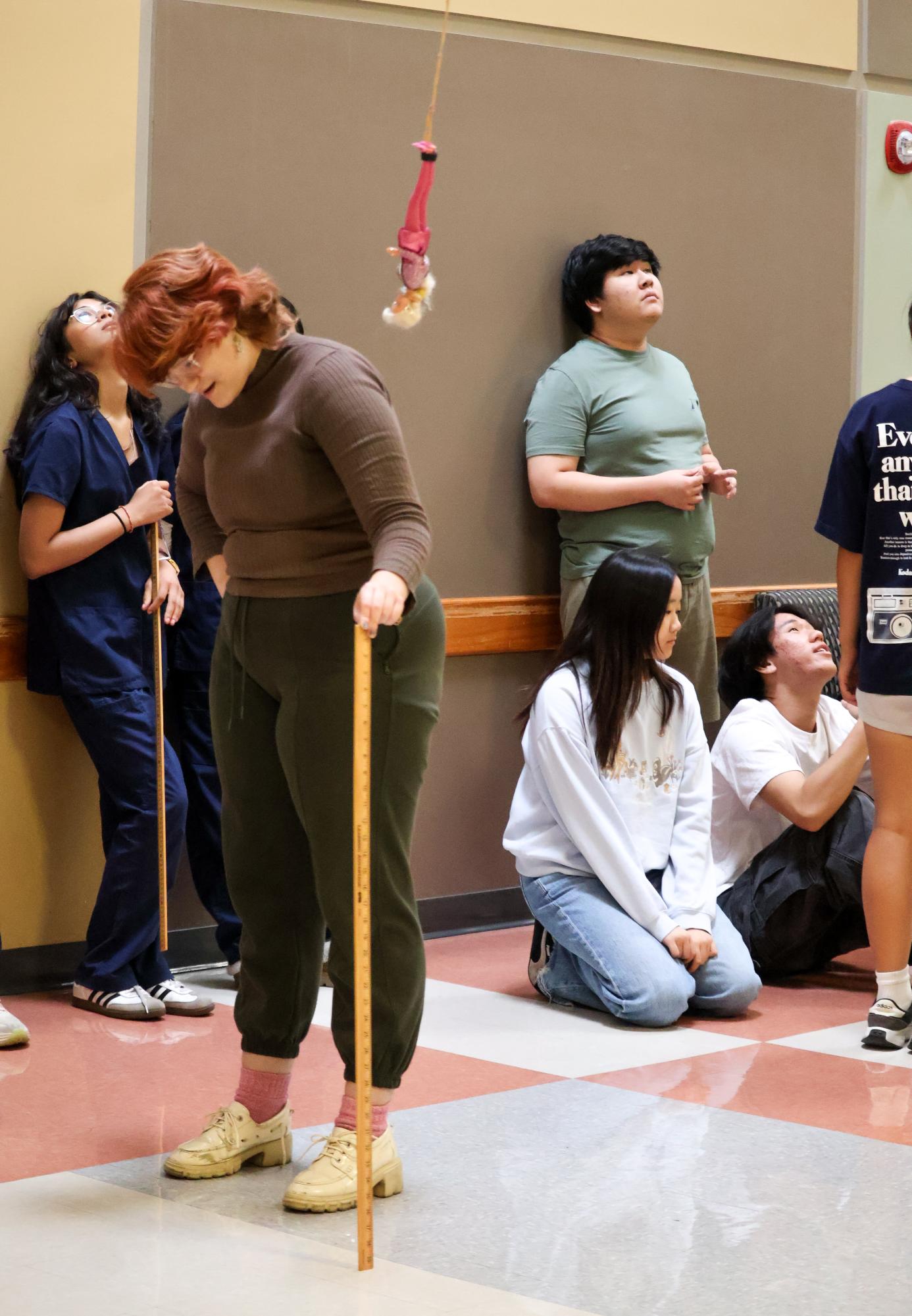
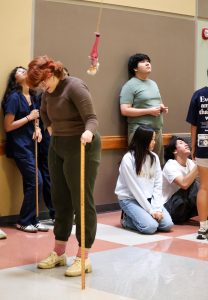
Holding a meter stick, Lana Monk ’26 gets ready to take a measurement of the incoming Barbie doll swinging towards the ground. Much of the excitement came from seeing the dolls tossed from the tall ledge.
-
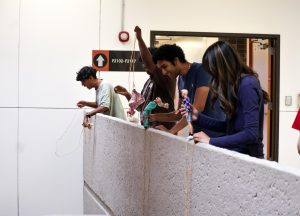
Smiling, Sudeep Tatineni ’26 looks over the ledge excitedly, preparing to drop his group’s doll. Group members below shouted with shock when they realized how close the dolls reached the ground.

Snaps of rubber bands and sounds of metersticks colliding against the whiteboard set the afternoon scene for the annual AP Statistics Barbie Bungee project on Wednesday, Oct. 15, and Thursday, Oct. 16, as AP Statistics teachers Allison Wells and Brian Youn directed students in launching Barbies off the F-wing stairwell.
Each group first chose their preferred Barbie with a friendly competition of “Rock Paper Scissors.” Then, they launched their Barbie over a classroom meterstick and graphed their data. Extrapolating their data, they figured out how many rubber bands they needed for the Barbie doll to stretch as far as possible without touching the ground after being tossed over a ledge.
“For my team, I was in charge of [looping] the rubber bands together so that we could use them for our project,” Rucha Kapadia ‘27 said. “[The project was] really fun because it was [cool] to see all the Barbies dangling down the stairwell. We don’t usually go out of our way to do these [kinds of] projects since in [class], there’s always lectures [going on].”
After collecting the necessary materials and filling out parts of their lab handout, the students headed to the F-wing hallway. One or two members of each group climbed the stairs to drop the doll while the rest of the teammates measured how far the Barbie dropped.
“The F-wing has a large ledge so I think it’s a good vantage point for releasing our bungee jumpers,” Ohm Shankar ‘27 said. “Right now, we’re learning about linear regressions, so I think [this project] really fits the theme of the unit we’re in now. We [used] rubber bands because we wanted to see how the number of bands correlates to the distance the barbie falls so [we can] create a linear regression scatterplot from that. [This project is] fun [and] pretty engaging. I think I gained a lot from [it].”
Shocked shouts echoed through the hallway as teams saw how far their dolls traveled based on their prediction. Some dolls briefly touched the ground before retracting, whereas other dolls collided with the ground brutally, giving their Barbies multiple concussions. After a couple of trials, the students regrouped and headed back to class to record their data and complete the rest of the lab analysis.
“AP Statistics isn’t a class that solely focuses on math,” Shankar said. “It’s more focused on interpreting the math behind everything and putting it into words rather than just calculating and plugging in numbers into variables and formulas. It tries to explain exactly why something happens and create a more meaningful explanation of all the math [underneath].”