-
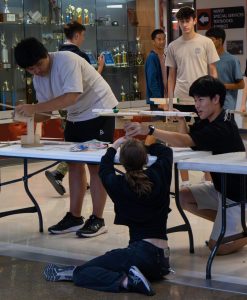
Right before takeoff, Haoxin Wang ’26 carefully lines up his team’s plane. Diligently working together for weeks, Wang’s team was ready to test their luck on competition day.

-
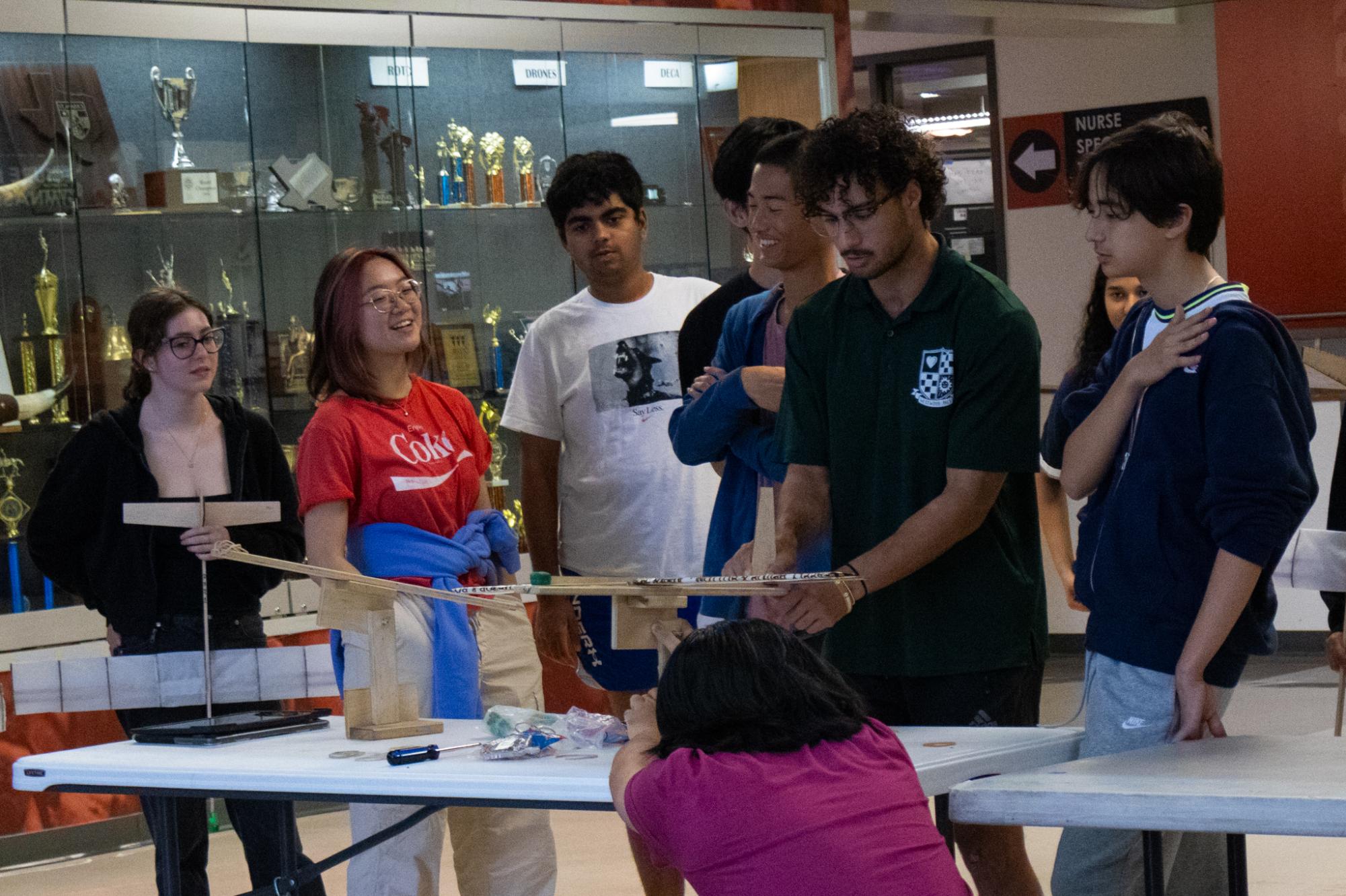
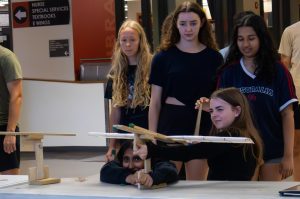
Getting ready for the perfect launch, Allie Jennings ’27 aims her group’s plane as juniors Audrey Cassidy, Shelly Bach, and Aanya Solanki watch. The Aerospace Engineering students applied technical skills when creating their plane.

-
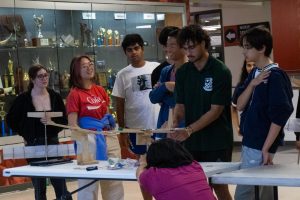
Carefully preparing for liftoff, Jack Kelly ’26 and Levi Kim ’27 get ready to let their plane hit the air. During a week of trial and error, their team fixed previous problems and had a successful flight on the competition day.
-
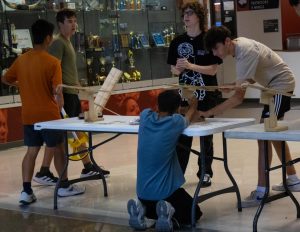
Pulling the rubber bands back, Sachin Modak ’27 carefully watches as his plane takes to the sky. Modak and his group carefully planned out an extraordinary plane that ended up doing great in competition.

-
Lining the up perfectly, Demian Medve ’27 prepares to launch his plane in the air. The most aerodynamic plane would be declared the winner.

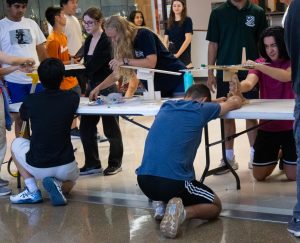
Testing their calculations and building skills, the Aerospace Engineering classes formed into teams and faced off in their plane competition on Wednesday, Oct. 15, and Tuesday, Oct. 21, during the second and seventh block in the atrium.
Teams received weeks of class time to work on the plane. Assigned the task of building the most aerodynamic plane, students utilized techniques they learned under the guidance of Aerospace Engineering teacher Joel Taylor. Over the course of the project, planes went through rigorous testing and redesigning.
“A significant amount of the success associated with projects like these where you have to build something is going to be the build quality itself,” Siddhant Kameswar ‘27 said. “We actually tested our design many times, and because of that, it felt like the plane itself got fatigued and it didn’t perform as well as some of the other planes, which were more fresh and hadn’t gone through as much testing.”
While only one team took home the win, every group put their plane through various tests, making calculations to ensure their plane had the straightest flight path. Every team incurred hardships: for example, Haoxin Wang ‘26 and his team overcame them efficiently, alternating between fixing structural issues and testing new solutions until they found the way that made it work.
“After testing a couple times, we quickly figured out that the paper was very weak, which is what made it break a few times,” Haoxin Wang ‘26 said. “However, after we carefully rewrapped the wing, the problem was easily solved.”
Taking up the majority of class, teams went head-to-head to see who could fly their plane the farthest. After two rounds of intense matchups, Rafael Dollet ‘26 and his team were crowned the champions of seventh block after their plane traveled 77.6 feet.
“One of the biggest things that helped our plane fly as well as it did was the fact we did a lot of research into what the best airfoil would be for lift-to-drag ratio,” Rafael Dollet ‘26 said. “The only thing that was different about our plane was our airfoil. It’s just the way we built it, and that helped us out.”
The ability to overcome challenges and modify prototypes was key to having a successful plane in this culmination of student projects. Every group’s plane launch succeeded on the first try. Across multiple classes, each team spent time and energy to refine and fix their model. Though some teams found that past problems resurfaced on the day of the competition, every team ultimately prevailed.
“For testing, we did get a lot of data when testing,” Kameswar said. “But I feel like with projects like this, there’s a trade-off between testing and making sure that it’ll still work well during the competition because ultimately at the end of the day, it’s not the tests that matter. It’s the final competition.”