-
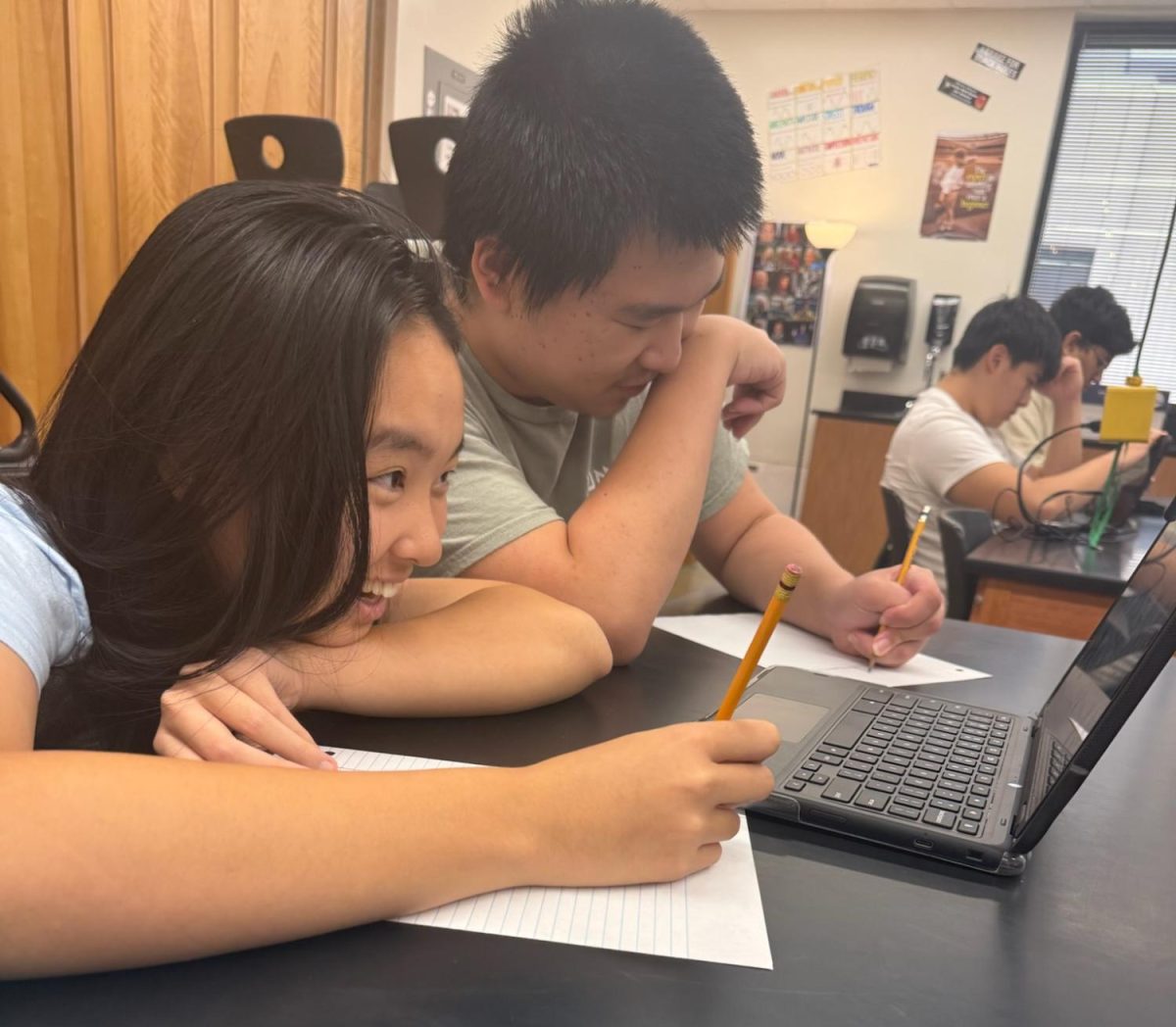
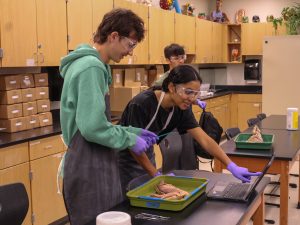
Pointing towards the computer, Ashka Rajbhandari ’28 points to the slides on her computer screen to Benjamin Harvey ’28. The two cut open a squid in hopes of finding internal body structures, including the ink sac. “[My favorite part was] probably the first cut and seeing all the organs and stuff [inside],” Harvey said. “I thought [the club] was fun, [especially since] I want to be in the medical field.”

-
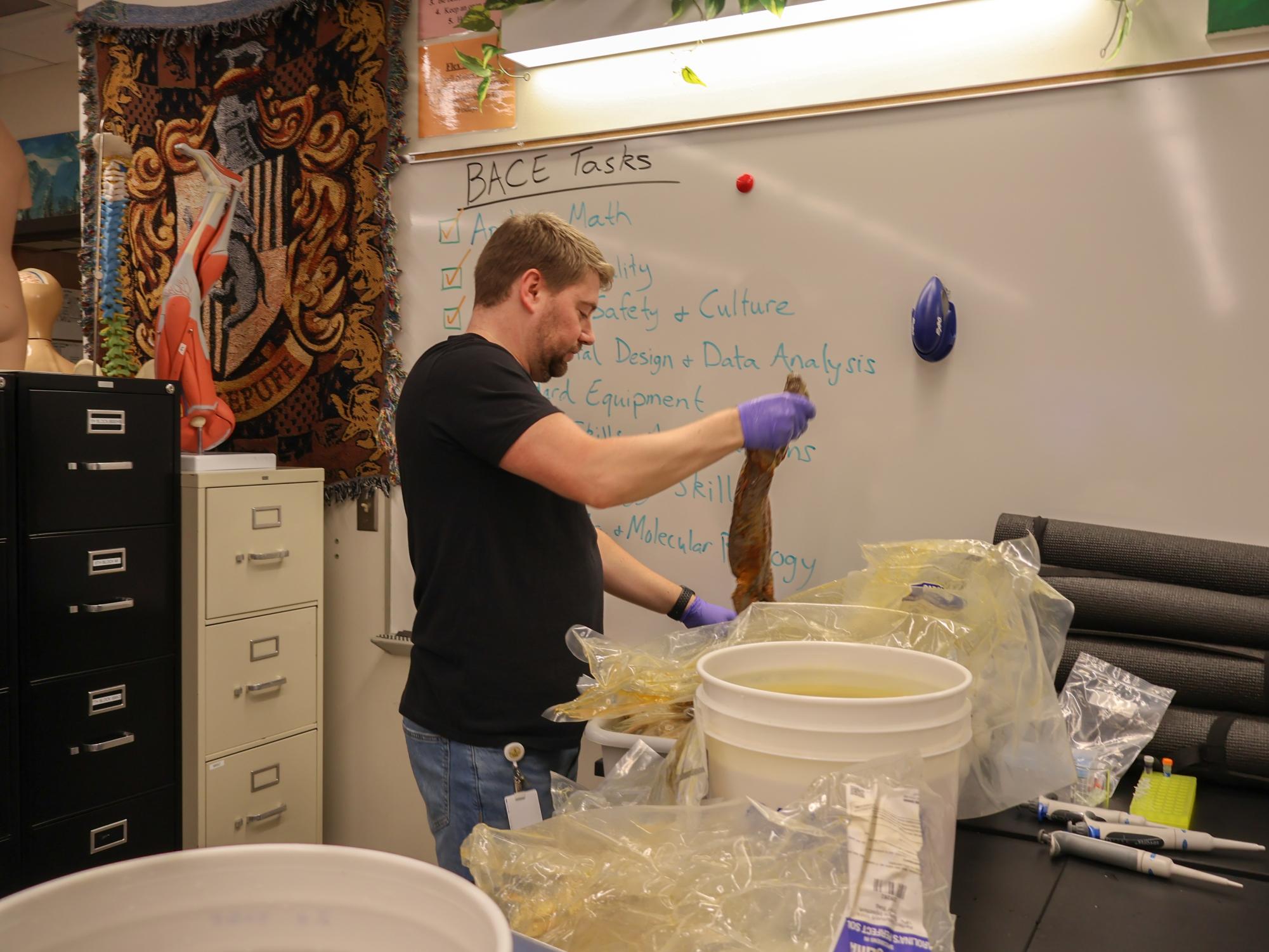
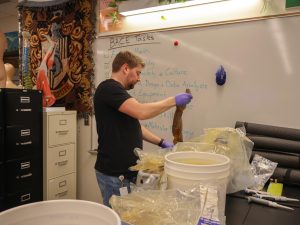
Holding a mink, Club Sponsor Eric Schieber pulls out a specimen from the formaldehyde-based preservative to give to students for dissection. Mr. Scheiber hosted the first meeting for Anatomy & Dissection Club, taking leftover specimens from prior meetings.
-
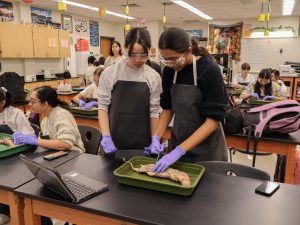
Focused on cutting through the veins, juniors Megan Luo and Shreya Chejara perform incisions on their iguana specimen. Following the first meeting of the year, Anatomy & Dissection Club members were given the opportunity to choose between three animals: iguanas, squid, and minks.

The strong odor of formaldehyde wafted across Anatomy & Dissection Club Sponsor Eric Scheiber’s room as members dissected iguanas, minks, and squid on Friday, Nov. 14 at the first dissection of the school year.
New and returning club members lined up at Mr. Scheiber’s desk to choose their specimen from a bucket of preserved animals. After returning to their table with the dissection tray, members pulled up an instructional slideshow made by officers detailing the recommended dissection procedure.
“We first started by taking the rough skin off of the iguana, and then we identified each organ in the body and took them out and looked at them,” Ella Smith ‘27 said. “[That was my favorite part:] getting to see all the different organs in my specimen.”
Though the specimen options were a hit with club members, Anatomy & Dissection officers originally intended for members to dissect salamanders at the first meeting. However, the salamanders did not arrive in time, causing the first meeting to be postponed. Despite this, logistical barriers resulted in the salamanders still not arriving, pushing officers to incorporate leftover specimens from dissections the year prior. The lack of salamanders didn’t dim members’ excitement, however — the familiarity allowed returning members to hone their skills on a particular specimen, and the novelty was welcomed by new members.
“I dissected the iguana because I did it last year and I really enjoyed it last year, so I decided to do it again,” Misha Baxamoosa ‘28 said. “Last year, I think I was newer to [dissections], so I didn’t know where everything was, because I wasn’t really a pro at human body systems, but now I am.”
Minks were the fan favorite of the three specimens. Using scalpels, members began the mink dissection with an incision down the middle, exposing the minks’ inner organs. Afterward, they poked around the innards using probes and forceps. Officers provided dissection tools, allowing members to fully explore various layers and components of their specimens.
“[My favorite part was] probably the first cut and seeing all the organs and stuff [inside],” Ben Harvey ‘28 said. “I thought [the club] was fun, [especially since] I want to be in the medical field.”
Members began dissecting iguanas by cutting open the skin with a scalpel to get to the heart. Similar to minks, students excitedly poked around the exposed heart, lungs, and inner gelatinous fluid within the iguanas. Though the minks were larger than the iguanas, that didn’t stop students from approaching the iguana dissections with equal fervor and curiosity.
“The skin of [the iguana] is really rough, so cutting it open was probably the hard part,” Misha Baxamoosa ‘28 said. “I liked looking at the organs of the iguana because it was really cool to see what it was eating at the time when it died. I saw a bug inside the stomach.”
Preparation of the specimens was of utmost importance to club officers and Mr. Scheiber. The animals were kept in the popular preservative formaldehyde. Dyes were injected into the animals’ veins to highlight their vascular systems, showing venous drainage and the blood vessels themselves. Spurred on by the dyes labeling the inner systems, some members chose to dissect a squid in hopes of finding the ink sack.
“[We chose the] squid because we thought it was cool how it was going to have an ink sack, but we couldn’t find it,” Harvey said. “At the end, we didn’t know if it had bones, but then we found some hard substance and we were not sure what it was.”
Through these dissections, students could see each internal component individually, enabling students to apply their theoretical body systems knowledge to a real-life specimen. This first meeting of the school year filled the room with excitement and chatter as many new members dissected an animal for the first time.
“We chose an iguana [because] it seemed pretty cool,” Smith said. “It was a little one, so it looked easy to dissect as well. It was awesome. I love it, and I can’t wait to come back in December.”