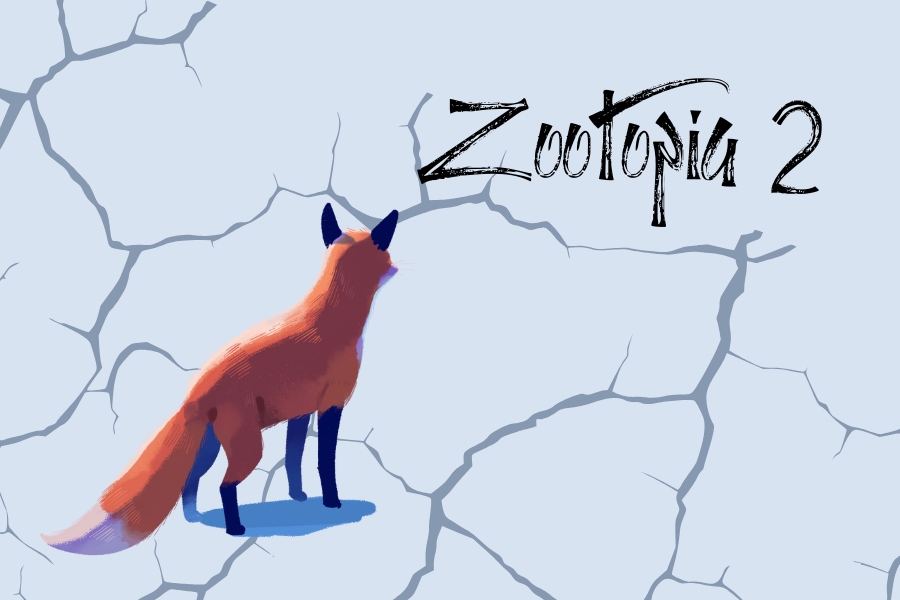
In a rare moment of besting the original film, the sequel Zootopia 2 offers everything its predecessor, released 10 years ago, presented and more. The sequel, released on Wednesday, Nov. 26, came at viewers with claws out, hooking them into its immediately engaging storyline: a chaotic car chase ending in the first hint at the plot.
Similar to the first movie, Zootopia 2 has the makings of an animated box office hit: smooth animation, expressive voice-acting, thoughtful world building, and an emotional score. Zootopia 2 builds off its antecedent’s world-building, referencing the aftermath of issues from the first movie and building off the absence of certain animals as a plot point. Though Zootopia is meant to be a place for anyone, certain groups of animals were missing in the first movie, and the second establishment hones in on the uncanny absence of reptiles.
For an action-packed movie, Zootopia 2 never sacrifices quality for efficiency. Every scene is built to perfection. Its defining characteristic, however, is its flawless storytelling that not-so-subtly comments on social systems of prejudice in society. The film is rampant with ups and downs and plot twists at every corner, keeping the audience on their toes. At its core, Zootopia 2 takes another step to unveiling the so-called “utopia” that is the metropolis of Zootopia, where “anyone can be anything”.
Zootopia 2 begins with a high-speed chase as protagonists and police partners Judy Hopps and Nick Wilde chase down a target, only to lead them to a greater mystery: a puzzling smuggling scheme. Not only does Zootopia 2 immediately put the viewer into the plotline, leaving the audience with more questions than answers, but it establishes the aftermath of the first movie. Hopps and Wilde are partners — first in justice, then in crime. Defying direct orders from their chief, Hopps and Wilde (Wilde and Hopps?) venture into a party hosted by the highest-profile family in Tundratown and discover a thrilling yet heartwrenching secret: the founding document of Zootopia, initially thought to be under threat of thievery, was simply being taken back by its rightful owner, a snake.
Upon realizing the high-profile family, the Lynxleys, are the villains, Hopps and Wilde protect the snake, making themselves enemies of Zootopia by the Lynxleys who want them dead. In one scene, the heroes of the city became their most wanteds. Zootopia 2 never fails in plot or storytelling, yet the richness of the storyline while meaningful social commentary is preserved is an aspiration many movies fail to achieve. Where Zootopia focused on the hostile relationships between predators and prey, Zootopia 2 focuses on the stigma around reptiles, paralleling systems of prejudice in the world right now.
The Zootopia franchise is no stranger to drawing on real-life experiences of prejudice in their movies. In fact, that is what drives the storyline in the first movie — and now the second. Reptiles are victims of prejudice, heavily due to the Lynxleys — a powerful family, similar to powerful authorities in the current world — spreading the lie that since reptiles have venom, a built-in defense mechanism, the entire group of animals are highly dangerous.
We’ve seen this before, from congressional committees framing homosexual individuals as mentally ill pedophiles to police officers and the media framing Black people as inherently criminal, inferior, and subhuman solely because of the color of their skin. Sexual orientation and race: both things inherent to a person. They’re things people are born with, just like how reptiles can’t change the fact that they’re reptiles, or that they have venom.
Zootopia 2 doesn’t just stop at prejudice, though. The movie doesn’t pull any punches when describing gentrification, the process in which a poor urban area is changed by wealthier people (the gentry) moving in, often building houses and businesses, thereby displacing current inhabitants.
In a shocking plot twist, it is revealed that the reptile town Reptile Ravine, founded by a snake, was a district designed to unite all animals at the beginning of Zootopia’s formation. Ebenezer Lynxley stole the snake’s work and buried the district under snow. During the time of the sequel, the remaining reptiles stayed in a hidden reptile hangout in Marsh Market. However, they faced a threat: the Lynxleys were going to expand their territory, turning the Marsh Market into Tundratown. Reptiles can’t survive the cold; they would die, and the Lynxleys, the gentry, wouldn’t have a care in the world.
The film shows the greed and callousness of the gentry, paralleling classist systems in society today. The reptiles are considered the bottom of the bottom, and thus, are paid no heed. Their lives would easily be sacrificed to line the Lynxleys’ wallets. Their own monetary gain comes above the well-being of those in lower classes than them — a familiar narrative.
Zootopia 2 presents its own unique issues, including gentrification, the wealth gap, classism, and power differences. It also extends issues that were the focus in the first movie, depicting how even though Wilde and Hopps succeeded in alleviating these issues, they can’t be erased completely, just like in real-life.
Though the first movie seems to end on a high note, where Wilde is accepted as trustworthy and good and Hopps is accepted as the first bunny police officer in the Zootopia Police Department (ZPD), the subtle discrimination against both of them continues in the second movie. Discrimination persists, both in the movie and in real life. Lines can be drawn between the pair’s treatment and the persistence of racism in the United States, as despite the Black Livers Matter (BLM) Movement, queer rights movement, and Stop Asian Hate Movement, casual discrimination endures today.
The film ensures it accurately represents the experience of thousands in their storytelling. Given the widespread nature of systemic oppression, good representation is important, and the Zootopia franchise does just that. Details such as how easily everyone believed a lynx created Zootopia rather than a snake shows how systems of justice and recognition are naturally catered toward the privileged, an event that resonates with many people of color and individuals from underserved communities.
Zootopia 2 also continues the system of politicians using fear and propaganda to gain personal power. In the first movie, mayors and celebrities utilized fear, built from lasting systems of inequality between predators and prey, to gain power. “Trust us,” they practically said, while further planting seeds of fear toward predators. When half of the population is against the other, everyone looks to a mentor, a guiding light, a paragon — something both mayors utilized in the first movie.
This continued in the second movie, yet they used reptiles as the source of fear instead. The Lynxleys recounted the “reptile attack” to scare the population into submission. To demonize Hopps and Wilde, they drew on the preconceived notion that reptiles were dangerous and scary. They were siding with the enemy, so they must be the enemy. The most wanted animals of Zootopia were on the loose, and the public believed that the Lynxleys were their salvation and protection.
Political corruption has been a rising point of discussion in the last couple of years, and Zootopia never shied away from it in both movies. In the first movie, corruption was rampant. Both mayors acted foolishly and irrationally, gathering police officers to do their dirty (and illegal) work. In Zootopia 2, the current Mayor of Zootopia, who had control over the ZPD, was bribed by the Lynxleys’ to put out hits on Wilde and Hopps. It is revealed that the Lynxleys helped him get the position of mayor in the first place, ensuring the Lynxleys a leg up in the city government. Just because corruption is called out in one place doesn’t make it stop in other places, and Zootopia 2 subtly touches on this, further derailing the utopian ideals that makes the metropolis so attractive.
Zootopia 2 is what we need in the current political environment. It has a huge reach, more than many politicians and activists. The movie’s audience consisted of adults who were around for the first movie as well as children experiencing their first Zootopia release. In fact, it reclaimed Disney’s No. 1 spot, became the seventh-biggest animated film in history, and crossed $1 billion globally in just 17 days. The film is more widespread than the first movie, gaining huge traction on social media even before its release.
There is something symbolic about a successful movie with left-leaning political undertones to reach such a wide audience. This is the political education the children of today need: easy to understand and digest while displaying the negative consequences of social systems of inequality. Children can form their own opinions while being presented with the full picture, consequences and all. In the movie, the city is advertised as a utopia to fulfill your dreams, yet through the franchise, Zootopia is shown to be just the opposite. As cracks in its facade are exposed, we are left wondering: if anyone can supposedly be anything, who is left out of “anyone”? So far, it has been bunnies, foxes, and reptiles. Who’s next?