

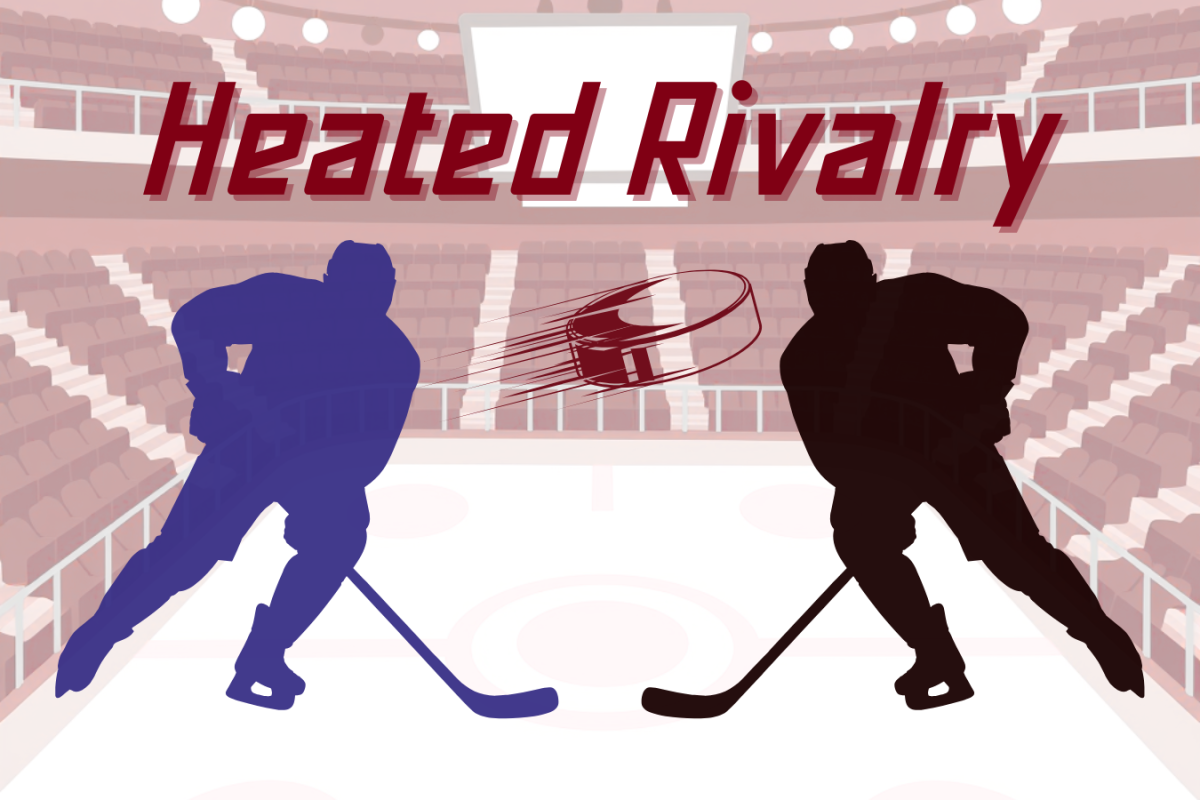
In one six-episode TV adaptation of a novel, an author received life-saving Parkinson’s disease treatment, a co-star skyrocketed from 39,000 followers to over one million followers on Instagram, Breaking Bad was dethroned as the singular titleholder of the Perfect 10 IMDb score, and the love story of two closeted hockey players captured the hearts of viewers across the world. Amassing over 600 million views on HBO Max only two weeks after its conclusion, Heated Rivalry weaves a beautiful tapestry of queer representation in traditionally masculine sports.
Heated Rivalry follows the two most talked-about prospects in its hockey world, Russia’s Ilya Rozanov and Canada’s Shane Hollander. Portrayed as media rivals, these two butt heads in their personal and public life — yet their eight-year love story persists. The show depicts their relationship progression on and off the ice while they discover their identity, deal with familial struggles, and come to terms with their relationship. Onscreen, their story appears to start physically intimate, but it was always romantic. A show appealing to the queer and straight community alike, Heated Rivalry pens a Shakespearean sonnet of the LGBTQ+ community: pure love, from start to finish.
The show experiments with an alternative queer temporality, the collapse of the social norm of time (including romantic and reproductive milestones) in queer lives. Forced into hiding by hockey culture and the sport’s normalization of homophobic language, the pair love on a tightrope, denying romantic confessions to avoid the pain of rejection — for both believe they were doomed from the start. Hidden behind physical intimacy, caustic remarks, and casual language are the secret hand brushes, international calls, tearful breakdowns, and subtly tender caresses spanning their careers.
Heated Rivalry plays with the concept of time and social milestones. While many heterosexual relationships start emotionally and progress physically, Shane’s and Ilya’s relationship seems to start physically. By the end of the show, however, viewers beg the question: wasn’t it always emotional? Prior to any contact, it was love at first sight, since the first time their eyes locked in the gym. Every action and thought had an undertone of emotional love from the start. Their status as hockey players prevented them from exploring love in a typical fashion, making the show a commentary on homophobia in traditionally masculine sports.
Racing against their relationship’s expiration date, when they’ll have to part ways to protect their careers, Ilya and Shane meet up every time they play each other, depicting messy desperation unlike any other. They are fighting a ticking time bomb, the day when their closet of safety inevitably shatters and they are forced apart. In raw realness, they are afraid of not just being found out, but of leaving each other. As queer men, as a Russian in the United States, as a half-Asian hockey player, as sports models appealing to the female gaze — the career-ruining secret consumes them, yet what they don’t know is they are binary stars, gravitationally bound for eternity. Against the odds, Ilya and Shane always reunite.
Heated Rivalry’s breakout popularity is fueled by how it allows two people to simply fall in love with each other’s souls, devoid of gender roles applied to media relationships. In most queer media, creators and fans alike assign a feminine role and a masculine role to partners, often stemming from the desire to appeal to straight audiences; for this reason, LGBTQ+ media tends to fall flat for the queer community. Flipping the script, Heated Rivalry portrays two men as equals in life and love. The show, filmed in only one month, is one of the most perfect, accurate representations of what it means to be a queer male sports player, what it means to hide and hurt, and what it means to surrender your last living breath for the sake of devotion.
In an interview, Hudson Williams, Shane’s actor, explains how he has received emails from queer hockey and football players telling him how much the show meant to them. When art has the capability to touch people’s lives, draw emotions, and craft a safe haven, even momentarily, that is every director’s dream: Heated Rivalry has fulfilled its purpose, shedding light on the toxic masculinity and rampant homophobia in the sports industry, paralleling the National Hockey League’s history of LGBTQ+ discrimination.
Breaking barriers, Heated Rivalry also co-stars a half-Asian, half-white gay man without giving in to the all-too-common gay Asian stereotypes. Gay Asians are deemed as feminine, undesirable, comedic relief, and the “gay best friend” to straight main characters, yet Shane is the complete opposite, portrayed as one of the most attractive hockey players. Simultaneously representing the queer Asian and neurodivergent communities, Shane’s environment hints at his reality as a closeted gay and autistic individual. His East Asian mother’s comment of a brand deal being “too white” and his family’s mildly homophobic jokes, despite their allyship, depict his reality of living in two worlds of marginalized communities. From asking where to put his shoes when entering Ilya’s house to folding his clothes prior to physical intimacy, the show does an extraordinary job of depicting an autistic, Asian individual without falling into tropes catering to the female gaze.
For the first time in a long time, the queer community has a piece of media made for them. Queer Asians are systemically underlooked in LGBTQ+ media; when they are present, it is not in a love story, but rather as a sidekick or accessory, like in Crazy Rich Asians and Entourage. Shane is an example of queer Asian representation done right. It is not enough to just have a gay Asian, and Heated Rivalry highlights the imperativeness of providing queer Asians with depth, not just sassy, comedic timing.
Heated Rivalry turns the “gay best friend” trope on its head, placing queer men at the forefront as their straight girl best friends take the backburner, refreshingly supporting their growth. In a beautiful lack of misogyny, the girl best friends, like Rose, Elena, and Svetlana, are representative of true womanhood: they unconditionally care for their people without homophobia. As both men exist on their own timeline, the audience is taken on a journey of richly woven romance, heartbreak, and gut-wrenching moments. In a similar vein, the story of the pair’s acquaintance hockey player, explored throughout episode three, seamlessly intersects with Shane’s and Ilya’s relationship progression, unknowingly changing the course of their lives and proving there is a space for queer love in professional hockey.
“You deserve sunshine,” Elena whispered to Scott Hunter, the acquaintance of the main pairing and another closeted gay hockey player, after Scott seemed unsure of his relationship with Kip Grady, a gay smoothie/juice-maker and bartender who is best friends with Elena. In episode three, Heated Rivalry temporarily shifts its focus to the story of Scott and Kip, depicting Scott’s anxiety attacks of being outed when dating Kip, and Kip’s resulting sadness and breakup.
Though the episode’s change in character focus initially left viewers confused, all is revealed in episode four. After winning the hockey championship, Scott calls Kip down from the audience. In a surprising, groundbreaking, and deeply emotional moment, Scott kisses Kip on the ice in front of the cameras as I’ll Believe in Anything by Wolf Parade plays in the background, singing “You deserve sunshine”. Scott makes history as the first openly queer hockey player, and as Shane and Ilya watch the televised coming out from their homes, a new reality opens up for them: a life of possibility, authenticity, and hope.
This was just one of the magnificently curated soundtracks, featuring indie hits such as My Moon, My Man and Sealion by Feist, All The Things She Said by t.A.T.u., and mangetout by Wet Leg. These age-old tracks’ resurgence on social media only amplifies the impact of this show. Countless edits and interviews, the actors’ invitation to the Golden Globes, their almost immediate journey from underdogs to globally recognized superstars — Heated Rivalry has built more than a fan following. It has built stability for talented actors, connected the queer community, and told the greatest love story of the decade.
Heated Rivalry is the queer community’s sunshine. As Ilya and Shane bask in the sunset’s orange hues at the cottage, the audience revels in the sun’s warm rays from where they’re watching. Through experimentation in queer temporality, Ilya’s and Shane’s secrecy, and Scott’s fear, the show mosaically masters gay Asian representation, being a queer and male sports player, living with autism, and loving in a world where society shackles your heart. Heated Rivalry inspires audiences to take it slow, take it easy, and live freely, for at the end of the day, love is a binary star system: gravitationally bound and never separated.






Isabelle • Jan 28, 2026 at 12:56 pm
half Asian that’s interesting!
Cara Chow • Jan 19, 2026 at 4:33 pm
vee!!! this is so beautiful and well-written, you are such a talented writer