“You will find your own American, too.”
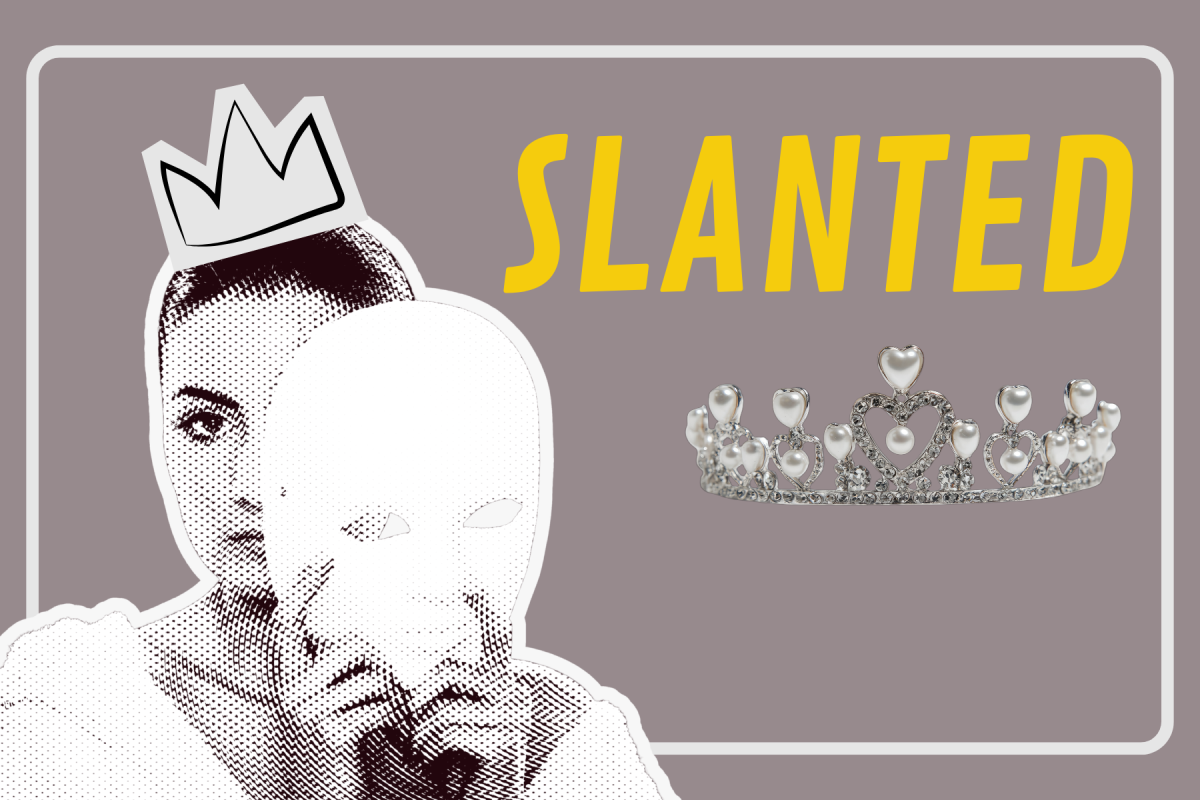
Growing up in America, Asian diaspora — people of Asian origin living outside their traditional homelands — often have one foot in either culture. Caught between American and Asian culture, they dangerously wobble on the tightrope dividing each world. Both feet can never be in one culture, whether because they are “too white for Asians” or “too Asian for whites”. For teenagers struggling to fit in, ethnic features juxtapose their native-level English, creating an uncomfortable contrast that bars Asian diaspora from both Asian and white spaces alike. Director Amy Wang’s debut film Slanted explores what happens when you remove that contrast through modification of ethnic features, eliminating the feeling of belonging to two worlds.
As director Amy Wang’s feature debut film, the satire body horror and comedy film Slanted released on Friday, March 13, yet the anticipation started long before with its casting, storyline, and cultural relevance in today’s racial environment. Starring McKenna Grace and Maitreyi Ramakrishnan, Slanted features a plot focused on a Chinese-American teenage girl, and reopens wounds about America’s longstanding history of blatant racism toward Asian-Americans, ones that we thought were buried in the 2010s.
Slanted centers on Chinese-American high schooler Joan Huang (played by Shirley Chen), who immigrated from China with her parents in fifth grade. Joan dreams of becoming prom queen, yet believes the only way to win is to look like all the past queens whose portraits line her high school walls. Upon discovering Ethnos, a cosmetic surgery clinic that turns people white through “ethnic modification,” Joan undergoes irreversible surgery and wakes up as a blonde destined for the crown. Through Joan’s internalized racism, Slanted explores themes of identity, self-hatred, and the dark cost of assimilation.
Setting the scene, Slanted crafts an environment eerily similar to the 2010s, from lighthearted aspects like skinny jeans and small restaurants to cultural environments of racial ostracism and microaggressions. Without a doubt, Slanted is an uncomfortable film to watch: Wang doesn’t shy away from depicting Joan’s self-hatred. Joan is shown using clothespins to pinch her nose, applying thick, blunt eyeliner to minimize the slant of her eyes, giving her best and only friend Brindha (played by Ramakrishnan) her mom’s homemade food, and above all, using the Ethnos filter on SnapChat to turn her hair blonde and features more white.
Bluntly, Joan hates herself, a depiction shocking some viewers who called for “better representation” instead of an Asian-American lead who despises herself to the core — but realistic representation is better than tales of falsehoods. In the 2010s, blatant racism lurked behind the closed mouths of nearly everyone, whether it was passerby on the streets, your cashier, or your tablemate in Algebra 2. It was beyond difficult for Asian-American teenagers, ones who were already struggling to find themselves, to accept their identity.
In Slanted, Joan’s self-hatred spreads outward, manifesting most explicitly through her bodily modification in a shocking neglect of her body. Her dream is to be prom queen, and the film depicts how far she is willing to go for her dream. Behind the surface of the carefully crafted cinematography and color grading, though, Joan’s dream of prom queen wasn’t just formed on a whim. As a child, she saw the social acceptance of prom queens — an acceptance motivated by whiteness. Joan’s dream of prom queen covers her greater goal: to feel the love that white people do.
After the ethnic modification surgery, Joan begins to go by a new name, Jo Hunt (played by Grace), and receives her dream endorsement of prom queen from Olivia, the school’s queen bee. Her social life seems perfect: she has her dream boyfriend and bright prospects for prom queen. Yet, behind closed doors, her crumbling relationship with her parents illuminates another aspect to the storyline. Joan’s erasure of everything that makes her Chinese — including her eyes, which her father says are her “grandma’s eyes” — puts her at odds with her parents.
As time progresses, her mask literally slips; her cosmetically-modified face begins to constantly sag and peel in various places. Her surgeon tells her this is natural, and provides her with cream and tape — but the lie was apparent. How could Joan’s sagging be natural if she was not natural in the first place? The film’s climax depicts her entire face emerging misshapen and deformed as she receives prom queen. In trying to look perfect, she ruined herself from the outside and inside.
Wrapping up the climax, the ending is tear-jerking, no matter what genre the viewer is most familiar with. For seasoned cinephiles, the ending itself is fairly predictable and ordinary, yet the emotional dialogue sets it apart from typical horror films. Joan collapses in her parents’ arms, acting like a vulnerable daughter and relying on her family for the first time in the film. Joan remains trapped in a self-imposed vessel that does not belong to her, yet her parents love her unconditionally despite the fact that she does not look like the daughter they have come to know and love.
Slanted ends with Joan frantically pulling off her fake, peeling face, with blood and bits strewn everywhere. The final shot is of Joan finally uncovering part of her original face: her eye — one of the slanted eyes she was originally deeply insecure about. It took Joan an entire, irreversible cosmetic procedure to discover that she would rather die than live as someone she is not, and through this, Wang elucidates to viewers a heartfelt story of accepting one’s culture in the face of adversity.
What’s emotional about the ending isn’t the plot points, but the intimate conversations Joan has with her parents as she expresses regret for undergoing the surgery. All she has ever wanted is to be loved and accepted, and psychologically, as humans, this makes sense. Ironically, though, her whiteness is what drives people from her in the end. As her external mask of whiteness degrades due to faulty surgery, making her face deformed — though still white — people turn on her almost immediately. Through this, she learns the lesson of the film: she must craft her own definition of what it means to be American.
Giving way to the broader message of Wang’s artistic piece is a quote from Joan’s dad: “Being American? Not the goal. The goal is opposite.” At its core, Slanted is a satirical cultural criticism on the myth of cultural assimilation, commenting on the harmful effects of internalized racism through the absurdist yet emotional story of Joan, reflecting trends seen across Asian diaspora. Slanted underscores how harmful this truly is by showing how the desperation to be accepted can lead to drastic actions, discouraging any viewers from taking drastic actions motivated by internalized racism.
The concept of homogeneity versus heterogeneity is present in fields such as biology, chemistry, statistics, and data science, and the film’s sketchy organization Ethnos capitalizes on the prevalence of this concept in their advertisement. In a world of heterogeneity, Ethnos strives to curb the “injustice of being a person of color” by transforming any deviation into yet another puzzle piece forming the ultimate homogeneous population. Slanted itself debates the pros and cons of homogeneity, where everyone is “equal” as white people, versus heterogeneity, where everyone is diverse. Despite Wang’s well-thought details in Slanted, though, there remains core issues that prevent the film from becoming something greater.
Slanted is one step away from becoming a cult classic like Jennifer’s Body, Mean Girls, and The Substance. Wang’s direction felt hesitant, like she was scared of diving too deep into the cultural critique aspect. After Joan’s surgery, Slanted had potential to explore the shift in Joan’s family and intrapersonal dynamics, yet instead, the film took the route of focusing more on her prom queen storyline. While the film was engaging, Slanted could have benefited from exploring more of how Joan internally dealt with her new position in society, since while she externally looked different, she was the same person on the inside.
The ultimate message was about how internalized racism is deeply harmful — but for most Asian-American teenagers, they rationally already know this. From what audiences saw in the trailer, Slanted’s defining point should have been its unique messaging about race and identity, yet the movie does not present viewers with anything novel. The messaging of the film ultimately fell flat, stopping at how internalized racism is harmful, but Wang’s potential to explore deeper themes is there. Her standout ability to craft an engaging film is evident; all she needs is to lean harder into her messaging and theatrical direction to turn her art into a timeless classic. Slanted is just the beginning for Wang.
Slanted is more than a stereotypical story of wanting to be prom queen: it’s a cinematic masterpiece exploring interpersonal dynamics in the high school environment. In attempting to craft the perfect profile, Joan destroys her looks, character, and identity. She loses herself, and the only way to find herself again is to undo her irreversible mistakes. Slanted is a cultural rewrite of finding oneself in a difficult position as a result of self-loathing and desperation. Whether it’s the family conversations to tug at the heartstrings, the absurd plot points, or the engaging cinematic style, this film is a must-watch for any Asian-American teen who has ever questioned their place in society.


![Gazing into the audience, Wes Autry ’26 as Mr. DePinna poses like the Discus Thrower as Mayla Montgomery ’26 as Penny Sycamore paints him. Mr. DePinna was especially absurd, requiring intense amounts of committment from Autry and resulting in an All-Star Cast honor at competiton. “I never expected anything like that,” Autry said. “[This is] the first year I’ve ever gone to UIL, and winning an award from it is gratifying. It’s something I never thought I would achieve, and so achieving that makes me feel like everything I’ve done here wasn’t pointless.”](https://westwoodhorizon.com/wp-content/uploads/2026/03/Screen-Shot-2026-03-25-at-3.28.43-PM-1200x799.png)