

-
Grinning, Ishaan Desai ’29, Rupal Jain ’27, Viktor Nguyen ’26, and Arhaan Jafri ’27 look on with pride as their robot completes a practice run. This pre-game ritual helped the robot drivers and drive coach relax and get into the rhythm of the matches before the stakes rose.

-
Dead set on the robot, Viktor Nguyen ’26 quickly runs cycles of shooting artifacts (game pieces) into the goal. Nguyen’s skill and experience in driving a robot was integral to Slingshot’s success during competition.

-
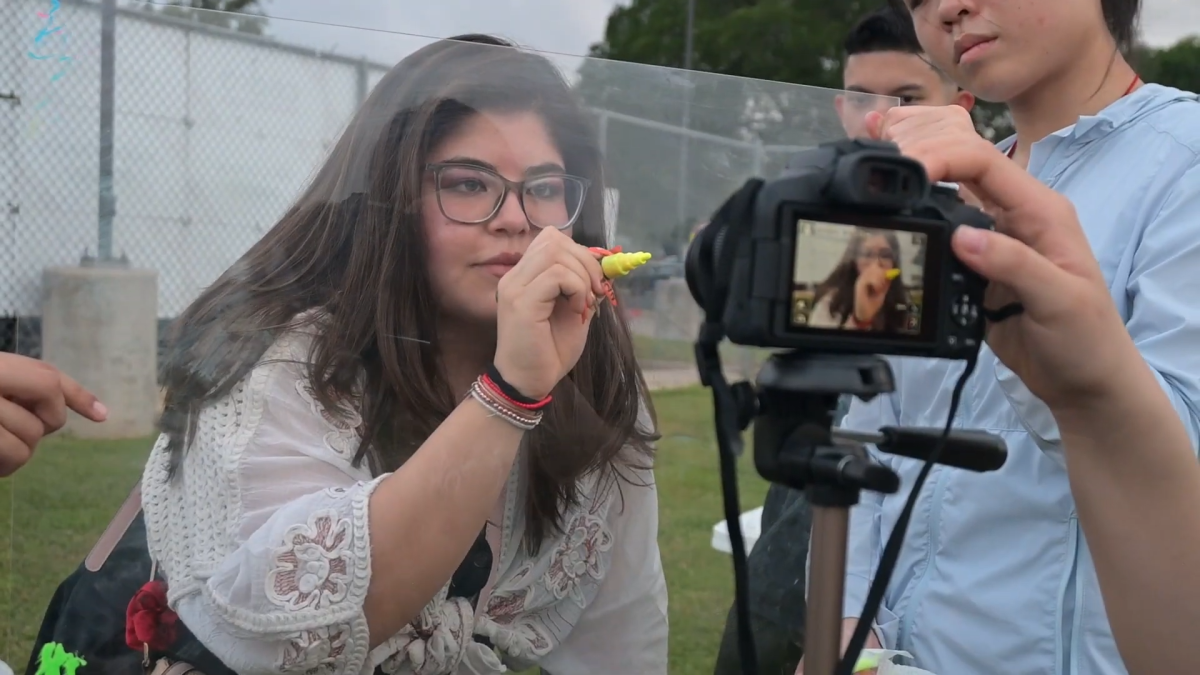
Begrudgingly, Jining Liu ’26 holds still while Aubrey Tipps ’26 paints a slingshot on his face. The face paint had originally only been for Slingshot’s presentation team, but became a fun activity that many students from opposing teams came to participate in.

-
Hands covering his mouth, Ishaan Desai ’29 stares in shock as he realizes Slingshot won their final qualification match. This match was especially crucial to Slingshot’s success as it bumped them up significantly in rank.

-
Confidently, Saanvi Bhosekar ’28 announces the team she hopes to form an alliance with, Athletech Robotics. As the representative for Hunga Munga in alliance selection, her request was accepted by Athletech Robotics and the pair went on to earn the title of Finalist Alliance.

-
Patting his back, Cosmobotics member Akshobhya Manthati ’26 praises Viktor Nguyen ’26, a member of their alliance team Slingshot, for his driving skills. As a show of mutual support, Cosmobotics and Slingshot members switched hoodies before playing the last games of the night.

-
Beaming, Aubrey Tipps ’26 and Rupal Jain ’27 embrace after a judging panel. Presentation teams acted as separate subgroups under each FTC team, trained to answer questions based on awards criteria.

-
Examining the robot, Tanner Sundstrom ’28 carefully checks the hardware before going into a match. Subgroups comprised of robot drivers, drive coach, and others focused on robot performance remained near the game arena at all times, moving to the practice field when not actively competing.

-
Smiling, Bhargav Sai Kancherlapalli ’29 and Adarsh Aruru ’27 put up streamers as decoration around their pit. Atlatl had many decorations including extra lights and mini axolotl squishmallows, which were their mascot.

-
Taking a break, Darryl Tang ’27 sits in the stands to watch a match. As one of the volunteers supporting the event, Tang was constantly running around to ensure every team was on the game field in time for their match.

-
Focused, Arhaan Jafri ’27 examines the wiring in the back of the robot. Something uniquely useful to Slingshot’s robot was the back plate that popped on and off with ease to reveal the wiring, which was an enormous help to hardware members.

-
Calmly, Minessh Uchat ’29 and Prahastha Pudi ’27 set up their pit. Each team had a pit decorated with their engineering portfolio, presentation, former achievements, and merch.

-
Discussing with her upcoming alliance partner, Saanvi Bhosekar ’28 questions the other team about their performance statistics. Most teams seeked out their alliances before a match in order to figure out how to merge their skill sets together.


The same weekend Superbowl fans awaited the most monumental football game of the year, First Tech Challenge (FTC) Robotics teams walked into Cedar Ridge High School with similar anticipation on Saturday, Feb. 7, for their FIRST in Texas (FiT) GEMS League Tournament. Defining which robotics teams either qualified for further competition or found themselves at the end of their season, stress ran high for Westwood Robotics teams Slingshot, Hunga Munga, Tomahawk, and Atlatl as they entered the tournament. With the chance to earn advancement points through their robot’s capacity and achieve further awards with their engineering portfolio, teams displayed efforts culminating long hours in the MakerSpace.
With the best performance streak Westwood Robotics has seen in years, varsity team Slingshot took home the coveted title of Winning Alliance Captain for their robot’s skills as well as the second-highest award of the competition, the second place Inspire Award. Rookie team Hunga Munga finished as Finalist Alliance Captain and won the second place Connect Award for their effective outreach in the engineering community and beyond. The first place Control Award was awarded to varsity team Tomahawk for their sensor and software efficiency, and rookie team Atlatl won the second place Think Award for their efficient design and programming. Both Slingshot and Hunga Munga directly advanced to the upcoming FiT-Central Texas Regional Championship, and Tomahawk directly advanced to the FiT-Central Austin Semi-Regional Championship.
“I think we have a really unique group of kids this year,” FTC Director Aubrey Tipps ‘26 said. “They’re really dedicated to working together and also working between our teams. We had a lot of mentorship between our varsity teams and our rookie teams. That really helped everyone develop their skillsets over the season, and there was also a big focus on awards this year and that helped a lot of teams boost their advancement.”
As the sun rose, students, parents, and sponsors flooded into the school’s halls. Teams split into subgroups to set up pits — display tables and tents — where teams showcased their robots, portfolios, posters, and prepare for their first trial of the day: presentations. Each team had five minutes to present a summary of their robot, followed by a ten minute Q&A from the designated judges who evaluated teams for potential awards.
“[Being on presentation team] was really nerve-racking,” Hunga Munga member Bao Nguyen ‘28 said. “I’m not always the strongest speaker, and I really wanted to do well for my team.”
After presentations concluded, qualification matches commenced at the same time as pit judging, splitting apart the teams. Robot drivers and drive coaches stuck to the tournament’s game arenas, dutifully tuning their robots’ performances on the practice fields. Meanwhile, the presentation team stayed in their pits waiting for further judging panels to assess award qualifications. This was a particularly stressful ritual for Slingshot, whose hardware lead, Jining Liu ‘26, was unavailable for the first panel of pit judging.
“[Since] we found out this timing issue so late, we had to speedrun the training of another hardware member, Niketh [Balakrishnan ‘29], for judging,” Slingshot member Rupal Jain ‘27 said. “He still did really well, but all of us were so happy and relieved when Jining got back. [It was] like a celebrity walked into our pit.”
The rookie teams were eager to test their robot’s skills in the high-risk competition. Though faced with difficulties collaborating with their randomly selected alliances, Atlatl displayed impressive speed and precision. These skills were a product of the immense development of their hardware and software subteams throughout their first season of FTC.
“[I was most proud] of how our robot performed,” Atlatl Captain Dalia Ahmed ‘28 said. “We got unlucky throughout our matches, but we still had a robot that was functioning [successfully], and we had an [autonomous program], so that was good.”
As qualification matches drew to an end, teams waited with bated breath by the ranking board since only the top six highest-ranking teams advanced to the elimination matches and would be allowed to pick their alliance — the team aiding them — in order of rank. In a surprising turn of events for the team, Slingshot rose to lead the scoreboard as the former first-ranking team lost their final qualification match.
“We weren’t expecting [to be first] at all,” Tipps said. “We were expecting top four, but now having the possibility [for] winning alliance captain was so [overwhelmingly exciting]. We all ran down the bleachers and hugged each other, and it was a really sweet moment.”
Slingshot, Hunga Munga, and Tomahawk progressed to the elimination matches with their alliance partners. In this round, the pressure on the robot drivers increased as the stakes and potential reward climbed higher. Hunga Munga, who had shocked contenders with their tremendous performance, felt the weight of their ambitions weighing heavily on their shoulders.
“I was really nervous before each match because driving can be unpredictable,” Nguyen said. “I didn’t want to make any mistakes during the match. I tried to stay calm and focused, and to just adapt during the matches.”
Slingshot, along with alliance team Cosmobotics, faced against Hunga Munga, who was allianced with Athletech Robotics, in the final match of the night. For the two minutes and 30 seconds of the game, camaraderie was put aside to focus on the prospective Winning Alliance title. As the best-performing robots of the night took to their final battle, Slingshot and Cosmobotics took an early lead in their Autonomous (robot function without human input) period, and together maintained this momentum throughout the match to seal their win with a final score of 268-120.
“It felt really good to be [the] Winning Alliance Captain, but we couldn’t have done it without our partner, Cosmobotics,” Slingshot Autonomous Lead Ishaan Desai ‘29 said. “Our position on the scoreboards were really all up to chance so close to the top, and whether or not [Slingshot was] captain, our partnership was what made our win special. It was hard making sure we would be able to function [to the best of our ability] together, but I was really thankful how we made it work in such [a] short time.”
All four Westwood Robotics teams received awards for various categories, fostering a sense of immense pride among students for the club’s efforts.
“Even though we were constantly competing against each other, [all the Westwood teams] were really excited for each [other’s wins],” Tipps said. “It just goes to show how uniquely cooperative and supportive our club is.”
With this monumental success fresh in their minds, the FTC teams start a new journey into higher-level competition. Tomahawk will fight for a Regionals slot at the FiT-Central Austin Semi-Regional Championship on Saturday, Feb. 14, and Slingshot and Hunga Munga are set to compete at the FiT-Central Texas Regional Championship on Saturday, March 7.




Cara Chow • Feb 13, 2026 at 2:06 pm
Wow, what a brilliant and thought provoking article, Yonnie Yang. Your whimsical writing has encouraged me to pursue robotics, and I have never once been more enticed by an article. Yonnie Yang should write for the New York Times.
awesome sauce • Feb 13, 2026 at 9:08 am
this is awesome sauce
Reesha • Feb 12, 2026 at 11:07 pm
This is an amazing article!! I loved the read and it sounds like an interesting event!!