


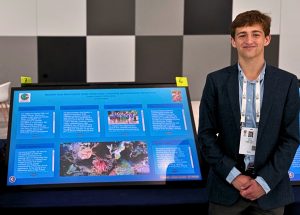
While most high school students were cramming for quizzes, Aubrey Teffer ‘26 was diving 30 feet below the surface of Tela Bay in Honduras. Later, he found himself halfway across the world in a packed conference room in Abu Dhabi, presenting his sea urchin research before top conservation scientists — a moment that felt bigger than anything he’d done before.
Aubrey’s journey to the International Union for Conservation of Nature’s (IUCN) World Conservation Congress (WCC) began with an unexpected opportunity: an Austin-based researcher was looking for volunteers with scuba qualifications to assist with environmental surveys in Honduras. Aubrey, part of the Westwood Swim and Dive team and used to balancing discipline in the pool with pressure underwater, got the invitation. The project itself was built on citizen science: volunteers and everyday community members partnering with researchers to collect meaningful, real-world data.
“Someone in my family was like, ‘I know a guy,’ and I got invited mostly because I had the experience diving and doing things underwater,” Aubrey said. “A couple of years ago, I went to [Tela Bay] to do the research. I was able to get solid data analysis done, and I wrote the proposals to get admitted.”
Despite the incredibly competitive acceptance rate, Aubrey earned a spot — one that placed him among researchers, policymakers, and conservation leaders. What happens at the IUCN affects communities worldwide, and for Aubrey, that global impact is exactly why his research mattered. The chance to take work he started as a teenager, born from a mix of swim-driven comfort in water and spontaneous opportunity, and bring it to a global decision-making arena was something he didn’t take lightly.
“The IUCN is an international conference and congress to decide environmental policy for the next four years,” Aubrey said. “I specifically went to the WCC, but it allows people to present research and findings that they’ve had in the subject of environmental science that’s useful to help spread the world. [The IUCN] is also helpful to propose and make large decisions regarding international policy.”
Aubrey worked with Tela Coral, an organization dedicated to researching and spreading awareness about Tela Bay’s coral reefs, and Families in Nature, a nonprofit aimed at teaching families about ecology and conservation. He spent months diving in Tela Bay’s coral reefs studying sea urchin populations, a keystone species crucial to the reef’s survival. Aubrey’s experience in the water, honed through years on the swim team, made the long hours of diving, surveying, and navigating reef structures feel surprisingly natural.
“I specifically monitored the urchin populations, and those are really important to the coral reef ecosystem,” Aubrey said. “They clear out algae to provide areas for coral reproduction and other things, and they have a very large population in Tela Bay.”
However, Aubrey also noticed abnormal patterns in the bay.
“[Tela Bay] has environmental anomalies with multiple species that are almost extinct in neighboring areas, but are in thriving populations [in the bay] despite the interesting conditions of the bay,” Aubrey said. “I specifically monitored the urchin populations, and I found multiple data trends that suggest disease resistance, because there’s been two mass mortality events, and there’s reasonable evidence that both mass mortality events were avoided or resisted somehow in the bay, [helping] narrow down what is separating this bay from other places and how it could possibly be replicated.”
His research didn’t just highlight ecological anomalies — it also spotlighted the importance of giving smaller communities a voice in international conservation efforts. At the WCC, Aubrey wasn’t just speaking for himself: he was elevating and expanding the work of conservationists in Tela who had been fighting to protect the reefs. For many local researchers, the conference represented something they rarely received: global visibility. With Aubrey’s help, smaller researchers in Tela hope to spread awareness surrounding coral reef health worldwide.
“[The IUCN] is a global program, so the policies that it makes will be enacted by places like the [United Nations] to be mandated worldwide,” Aubrey said. “The policy that it makes impacts things on a local scale, but also gives the opportunity for local places to present their findings and contribute to national, international, or global issues. The group that I’m based in is this town in Honduras, and they’ve had trouble getting to an international stage in the past. This is a really good opportunity to bring that research to a global scale.”
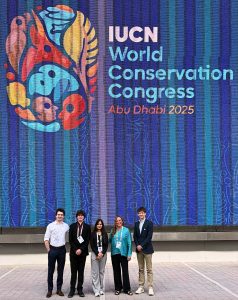
For Aubrey, this milestone came from embracing the unexpected. What started as a family connection, plus his swim-driven comfort underwater, turned into a project that reshaped the trajectory of his goals. For fellow students watching his journey, Aubrey hopes it becomes a reminder that taking risks, saying yes to unfamiliar challenges, and trusting in strengths opens doors to future career opportunities.
“The opportunity [inspired me to start the project]. A couple years ago, I went to the bay to do the research,” Aubrey said. “I got the opportunity through some connections that I had with family, so it was kind of just luck [in achieving this milestone].”
While he jokes that the experience was mostly beneficial for college applications, the significance of his work stretches far beyond that. From the vibrant reefs of Honduras to the global stage in Abu Dhabi, Aubrey discovered the power of research, community, and the courage to dive into something new.
“Presenting was a real honor. It felt really nice to be given the stage to say things and do my best to contribute to something,” Aubrey said. “Growing up, you feel like you’re just learning things and not doing anything, but this really did feel like I was doing something — like I was contributing to the world.”





Preeya Panwalker • Dec 2, 2025 at 12:18 pm
Fire article Cara!!! You get 10 big booms!!!
Yonnie Yang • Nov 22, 2025 at 12:19 am
so good Cara!! such an interesting story