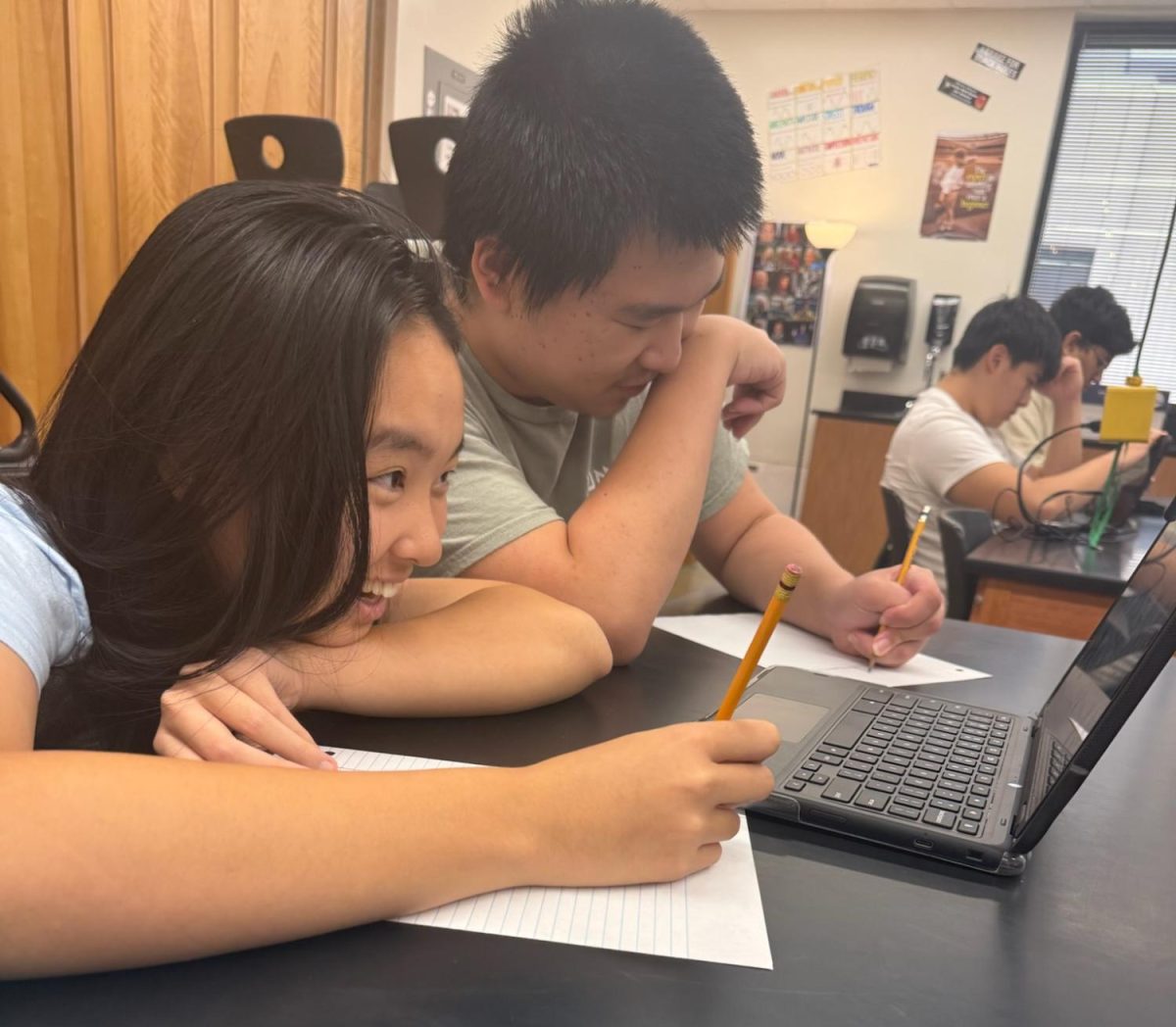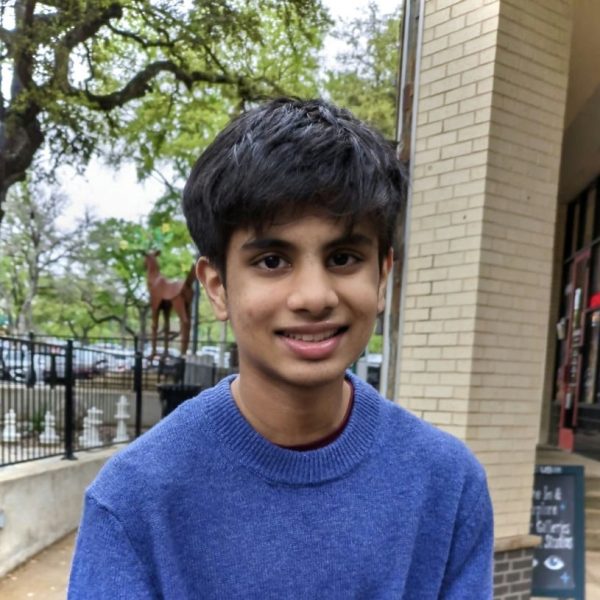

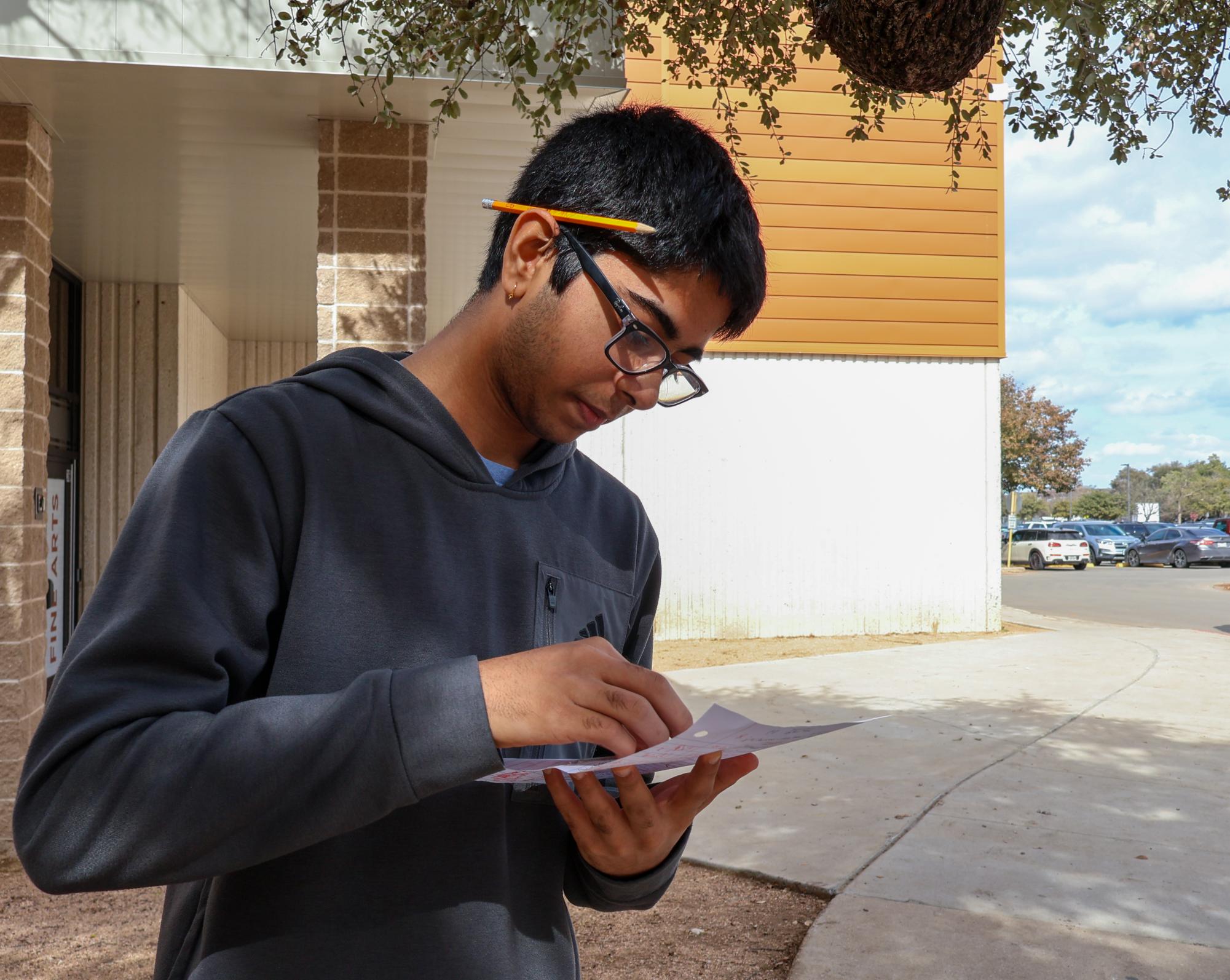
It’s 11:02 a.m., and the bell for lunch rings as students pack up and prepare to leave. Everyone’s in a rush to get to their first break of the day and catch up with friends — everyone besides Amogh Akella ‘26. Amogh nervously refreshes his browser, awaiting the results of the Regeneron Science and Talent Search (STS). Refresh. Nothing. A quick glance at his email, then another glance at the Regeneron website. Refresh. Nothing again. Another glance at his email, and a new email appears: “Congratulations, Regeneron Science Talent Search Scholar.” With a sigh of relief, Amogh puts his things away, a smile on his face.
Each year, the Society For Science, in tandem with Regeneron Pharmaceuticals, hosts the Regeneron STS for high school seniors. Once referred to as the “superbowl of science,” the competition selects 300 applicants to receive a $2000 dollar cash prize. 40 finalists are selected and flown out to Washington D.C. for a week to discuss their research with judges as they compete for cash prizes of up to $250,000. Students submit research across disciplines, including computer science, physics, and biology. As one of the 300 scholars, Amogh’s choice was in a field he’s been passionate about since a young age — math.
“[My passion for mathematics] started when I was four,” Amogh said. “I don’t really have any memory of a realization [of my passion], but [the catalyst] was my parents. When we [were] driving in the car to preschool, my parents used to teach me multiplication tables. Throughout school, I took [my passion] further, I took some advanced math classes pretty early on. In my middle school years, I got into competition math, so I participated in something called MathCounts, the American Math Competition, and the American Invitational Math Exam.”
Amogh’s research was in graph theory, a branch of math that seeks to understand the relationship between objects. He chose graph theory because of its approachable nature, making it easy to connect to other fields. Amogh studied diameter bounds for friends-and-strangers graphs, with his paper’s arXiv description explaining how the study aimed to “show that the distance between any pair of configurations is almost always polynomially bounded under certain conditions on the edge probabilities.” Though his research appears complex, in Amogh’s eyes, it’s really just dots and lines arranged systematically on paper.
“I wouldn’t say that graph theory is an exceedingly complex field,” Amogh said. “[In fact], the reason that graph theory is useful is because of its abstractness. It’s just [analyzing] a bunch of dots connected by lines. That’s a graph. There are some extremely deep theorems and stuff, but it’s all very understandable. I [could] go up to a 5th grader and show [them] something like Euler’s formula, and [they] would understand it.”
However, despite graph theory’s approachability, the implications of Amogh’s research are far reaching and have the power to revolutionize certain aspects of society.
“[My research] has certain implications in fields as economics [through] trading algorithms and theoretical computer science because [it] shows that certain puzzles can be solved quickly,” Amogh said. “It [also] lets us [understand] reconfigurations of networks, drones, and robots.”
Amogh’s focus on how his research could benefit the world reflects his broader desire to spread his passion for math and influence the way society works for the better, ultimately setting his research apart from a typical science project to pad their resumé.
“[I feel] like as a researcher, I feel like I’m actually contributing to science. I really like that feeling, like I’m actually making a difference in this world,” Amogh said. “Typically I research stuff that I’m interested in and that I find [interesting]. [I really enjoy] the rush and the thrill of making a contribution to today’s world.”
Amogh’s desire to spread his passion extends beyond research. A stark contrast to other passion projects that are characterized by sweaty desperation rather than actual passion, Amogh’s research represents a conscious, real effort to ensure that those around him understand the beauty of the mathematical form. This effort is exemplified not only by Amogh’s research, but also by how he uses his knowledge to spread the joy of math across age groups.
“I’ve done a lot of teaching and volunteer work, so currently I’m the head coach of the Canyon Vista MathCounts team,” Amogh said. “I help students prepare for the competition. I’ve sent multiple students to [the] state [competition] who have done extremely well. I just enjoy teaching students and imparting my knowledge and love and math into [others].”
MathCounts, the premier national middle school math competition, has received press for its intense competitions that pit the wits of some of the most mathematically gifted students across the nation against each other. Competitions like this, though a great representation of the capabilities of some of the hardest-working middle schoolers in the nation, are also a great representation of the inequality in math skills across the board. The Department of Education found that nearly 88% of students named math as their most challenging or disliked subject. For Amogh, this problem is acute, but his remedy is simple: just change how you think.
“I would say that I think what [most] people think is that math is like the study of numbers, but I disagree,” Amogh said. “For instance, in fields such as abstract algebra, you’re not studying numbers; you’re studying generalizations of groups of objects that are kind of like numbers. In fields like combinatorics, you’re really just studying counting, but in a very abstract sense. I think what school math fails to capture is that math is actually a really abstract subject. Viewing it as a more abstract subject would help students perhaps better understand things rather than having to view it as a formula that you must get right every time.”
Perhaps one of the most studied fields in the world, math has consumed the last 14 years of Amogh’s life, and he hopes to continue immersing himself in the field throughout college. From practicing multiplication problems in the car at age four to receiving national awards for high-level research, Amogh’s extensive experience with math represents a true, lifelong dedication to the field. This fall, Amogh will attend the Massachusetts Institute of Technology (MIT) and hopes to major in math.
“I’ll say that I’m a very mathematical person. I kind of live and breathe math. I’ll see everyday situations in terms of mathematics,” Amogh said. “If I’m doing something, I’ll subconsciously be mathematically analyzing it in my head. Sometimes I even solve problems in my dreams.”
Regeneron emphasizes that the competition seeks out “young people who are passionate about innovation and using scientific discovery to contribute to improving our world.” For Amogh, this is exemplified by how he approaches math not as something to exploit for his own personal gain, but rather a common treasure that everyone must have access to.
“I think that in school, an emphasis is placed on formulaic problem solving. You learn a specific method of problem solving, you’ll practice it on 10 problems, and maybe it’ll show up on the test. You leave with a great understanding of that specific concept, but I think that it would help if more broader areas of mathematics are taught,” Amogh said. “I think that math should be taught a lot more conceptually so that students understand the ideas behind the math rather than just the formulas. That’s the number one area that we need to improve in terms of math awareness. I think that when we teach our students [like] that, a lot more people will be drawn to math.”
Amogh’s paper for his award-winning research, in collaboration with Stanford Mathematics PhD student Rupert Li, can be read below as well as via his arXiv publication.



![Talking animatedly, Advanced Placement (AP) World History teacher Misty Matthews guides students through the lesson. Ms. Matthews has been a key component to the Westwood history department, getting to grow alongside the student body. “I first started [teaching] at Westwood around 2010 and kids would've all felt a certain way but now it's way different," Ms. Matthews said. “Sometimes it's divided and it's interesting how things have changed. But I have to do my best to teach facts."](https://westwoodhorizon.com/wp-content/uploads/2026/02/2026-02-10_MissMatthews_Preeya-1-1200x800.jpg)