
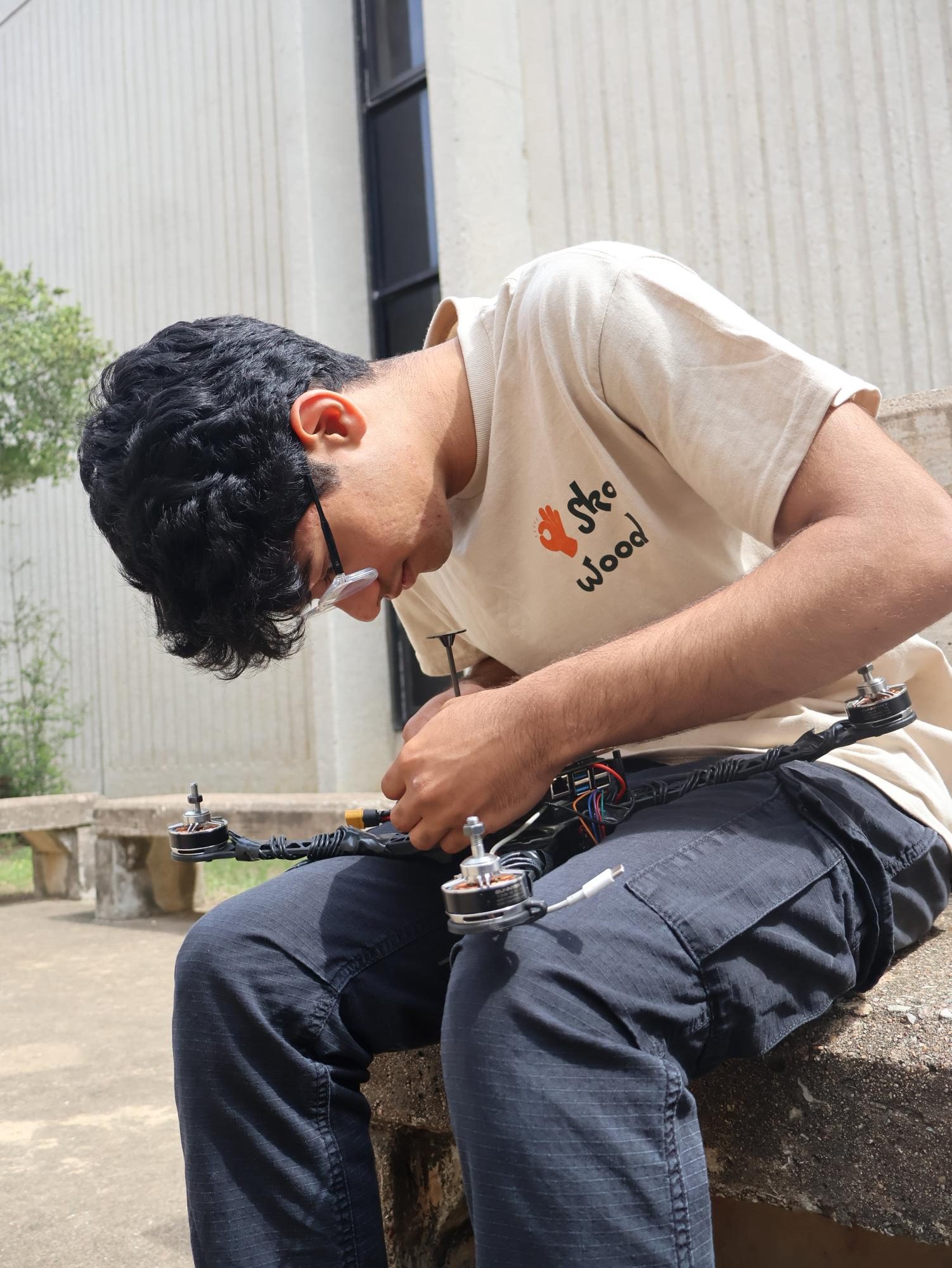
Late into the night before competition, Sol Mahajan ’26 stares at the ceiling of his hotel room in Columbus, Ohio. Tomorrow, he presents his project, a drone which runs using a Pixhawk 4 and a companion computer Raspberry Pi 5 as its brains, paired with a linear actuator to grab a large variety of building materials, at the Regeneron International Science and Engineering Fair (ISEF) — the gold standard of science research competitions, where students from across the globe showcase innovative solutions to real-world problems. The distance from his Texas home feels immeasurable, but it’s nothing compared to how far he’s traveled from where he began.
The inspiration for Sol’s project came from an unexpected source: the 2022 FIFA World Cup in Qatar. While millions of viewers focused on the matches, Sol noticed something troubling in the background.
“I was watching the World Cup and I noticed a lot of human rights abuses there,” Sol said. “This was taking place specifically in building stadiums. So I was thinking, how can I make a difference that would fix that?”
The 2022 World Cup heavily relied on over two million migrant workers to build the stadium, leading to high mortality rates. Witnessing this sparked an ambitious engineering vision in Sol: automate building tasks to reduce human rights abuses. Learning the mechanisms of flight controllers, Sol used this knowledge to design a drone framework that was capable of building infrastructure. Focusing on construction technology, he attempted to build a system where different drones could be equipped with specialized components to perform various building tasks. He also strived to make this drone fully autonomous. In Sol’s vision, this autonomy would diminish the need of manual labor in building, making construction safer and more efficient.
“What I came up with was essentially like a framework for building, where you can have different modular components that can go in different drones,” Sol said. “You could have one which has a robotic arm that lays bricks [and] one which lays cement and does other similar things.”
Sol’s engineering journey, like many Westwood students, began in his Engineering Career and Technical Education (CTE) class pathway. In the sophomore-level class Introduction to Engineering Design (IED), he created his first real project: a Mario-themed contraption where a character jumped and hit a block to light it up.
“I built a custom gyroscope paired with an Arduino microcontroller,” Sol said. “It was really interesting because I didn’t use the library and I was just writing the code by hand. It was just fun seeing how these different systems work under the hood.”
Though his Mario-themed project arose from an IED class grade, his primary motivation wasn’t the grade, but rather his desire to advance his engineering skills and solve real-world problems. When a friend first told Sol about ISEF, his response was laid-back. To him, the appeal was being able to work on a new project, not the competition itself. Starting the preparation for the Greater Austin Regional Science and Engineering Fair (GARSEF), the first fair in the path to ISEF, he focused more on the project than the actual competition.
“I didn’t expect to win anything,” Sol said. “The night before, I was considering whether I should go or not because I didn’t really think I would do much. I was like, ‘maybe I should just go to school instead,’ but my mom had already printed out the board, so I was like, ‘I guess I got to go.’”
Sol wrote half of his presentation script in the car on the way to GARSEF with a photo of professional football player Lionel Messi pulled up on his laptop to reference where it all started: the Qatar World Cup. When he advanced to the second round of judging, Sol didn’t initially grasp what it meant. After presenting to the second round of judges, Sol placed first in his category of Embedded Systems and earned the prestigious Best of Fair, awarded to the top six projects at the fair. With his Best of Fair, Sol earned a direct ticket to the international level of competition, ISEF, instead of the state level like most finalists.
“I thought everybody just got selected, so I was just calm,” Sol said. “But the people came and they took a photo with me.”
The realization of his achievement sparked a new level of dedication. Going into ISEF, Sol completely redesigned his presentation board, something uncommon among finalists. Typically, finalists take the time before ISEF to practice presenting, brushing up on key points and concepts. Sol, by contrast, switched his design to create something more logical and professional. The night before the big day, Sol practiced his speech repeatedly in his hotel room, strategically crafting talking points to guide judges toward questions he wanted them to ask.
“My first board was really bad,” Sol said. “Looking back, I think it did not clearly convey what I wanted people to take away from my project. I think past the first stage, I probably put more thought into this than I did in the actual drone itself.”
When Sol finally arrived in Columbus, Ohio, for ISEF, he discovered something beyond the competition itself. At ISEF, Sol encountered students from around the world who shared his interests and passions and explored cutting-edge projects that pushed the boundaries of science and engineering. Between presentations, he played chess with competitors, building long-lasting friendships.
“I realized that there’s always people who are into what you’re into,” Sol said. “I thought some of the software I was using was pretty niche. No one’s really going to care about this. But then I met people around the globe who cared about the same stuff I did.”
For a student who had worried his interests were too obscure, finding a community within his scientific niche — automation in aviation — was unexpected. Participating in ISEF can be a meaningful way to enhance a college application, or like for Sol, the start of something big: an affirmation that his passion was worth pursuing professionally, and a comfort that no matter where he goes in the future, he will be respected for doing what he does best. Sol believes that following your passions, no matter how different they are from the crowd, is essential for young engineers.
“Don’t do a crazy, very flashy project. Just do what you’re passionate about,” Sol said. “I think judges are genuinely able to tell if you’re passionate about something. If you’re passionate about something, work on that. The judges will look through you if you’re making stuff up, or if you aren’t as well-versed with the field as you show yourself to be.”
His advice is born from experience, a reminder that authenticity matters more than complexity and genuine curiosity can take high schoolers further than manufactured ambition. Sol’s ISEF project employed open-source tools such as GPS methods and third-party flight controllers, but he’s already looking ahead to more mathematically rigorous challenges. For Sol, the drone project that took him to Columbus was just the beginning.
“I’m trying to get into more math-heavy stuff,” Sol said. “More rigorous projects. Something that doesn’t use abstracted libraries, but something that involves me doing most of the work. I don’t want to be that one guy who uses a few libraries and calls it a day. I want to truly understand and use. This is something that I also want to pursue in college now that high school is ending.”
Despite his international success, Sol remains the same student who once hand-coded a simple Mario project in IED, driven by the same curiosity for understanding how systems work. Through the science fair, however, Sol gained confidence in his research skills. To Sol, ISEF provided him with the knowledge that the world is full of problems waiting to be solved, and that somewhere out there, people are waiting to meet the person who will solve them.
“I think ISEF, looking at other projects helped me recognize and identify other problems that can be helped with engineering,” Sol said. “Hopefully, in the future I can work on some of these.”
Sol’s journey from a sophomore engineering class to the international stage of ISEF was one of passion and perseverance. For other Westwood students with big ideas and late-night dreams, Sol’s story offers a simple message: start where you are, build what matters to you, and see how far it takes you.
“Over time, I think I have realized what matters to me,” Sol said. “I know now that engineering is one of those things. I think I am pretty lucky to discover this passion early on, because now I can spend the rest of my life working on [engineering] and hopefully better the society in the process.”


![Talking animatedly, Advanced Placement (AP) World History teacher Misty Matthews guides students through the lesson. Ms. Matthews has been a key component to the Westwood history department, getting to grow alongside the student body. “I first started [teaching] at Westwood around 2010 and kids would've all felt a certain way but now it's way different," Ms. Matthews said. “Sometimes it's divided and it's interesting how things have changed. But I have to do my best to teach facts."](https://westwoodhorizon.com/wp-content/uploads/2026/02/2026-02-10_MissMatthews_Preeya-1-1200x800.jpg)