

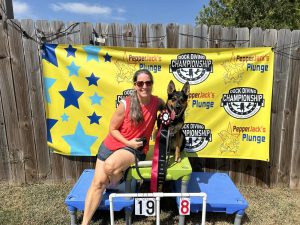
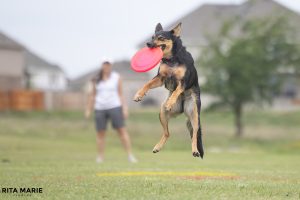
![Leaping off the dock, German teacher Jennifer Melgar's dog Zuki participates in dock diving under her guidance. Dock diving is primarily a summer sport that Zuki, a cattle dog and German Shepherd mix, trains for with Frau Melgar. "[To train for] dock diving, we have to reserve the pool and have to reserve a trainer," Frau Melgar said. "We didn't do a whole lot this past summer because my dog went into heat, and so she's still learning [and is] still very new to it."](https://westwoodhorizon.com/wp-content/uploads/2025/11/2025-IDS-Championships-1359.jpg)
During the day, Frau Jennifer Melgar guides students through the dialects and diction of German, but after the ring of the final bell, she steps into the world of competitive dog training and sports. Alongside her dogs, Frau Melgar takes the lead in competitions ranging from scent detection to dock diving to high-speed flyball, turning a beautiful passion into an incredible hobby and inspiring story.
Frau Melgar’s story started with her rescue dogs: Lucy, a Cairn Terrier; Zuki, a Cattle Dog and German Shepherd mix; and Bucky, a mutt. Having rescued Zuki and Bucky herself, Frau Melgar competes with the two dogs in a variety of events.
“Bucky is a mutt we found at Buc-ees, [which is] why his name is Bucky,” Frau Melgar said. “Zuki is our newest dog, [and] he’s about a year and a half old. My husband saw her get hit by two cars, and we got her to an emergency vet and worked with Rescue Texas to get her the care that she needed. Then, we were able to adopt her at 12 weeks old.”
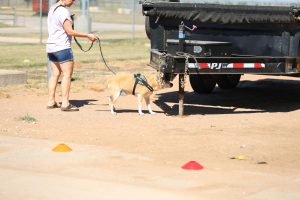
Frau Melgar began training Bucky in nose work (also known as scent work) during COVID-19 in an outdoor facility before they began competing. These competitions mimic real-life scenarios of dogs searching with police officers, where dogs find specific scents in various environments, alerting their handler after locating the scent.
“They use odors like birch, anise, and clove, and it’s how fast they can search,” Frau Melgar said. “They have different types of elements to mimic what dogs in the real world would be doing if they were working with a police officer. You have container searches to mimic working with [Transportation Security Administration] at the airport, being able to search luggage and such or buried searches to mimic cadaver dogs that are searching for dead bodies, vehicle searches and such.”
COVID was an important stepping stone for Frau Melgar to get her dogs into competitions, by providing consistent training throughout the week.
“COVID was the big piece [because] there wasn’t a whole lot to do [since] you couldn’t go anywhere [and] you had to stay far away from people,” Frau Melgar said. “With my dog Bucky, [in] the training center that we were already going to, the dogs had to be 10 feet apart. It was an outdoor facility, and so we kept looking at what they had to offer, and nose work was the sport that they had that my dog really enjoyed doing.”
For Frau Melgar, training with Bucky provided core memories and support during the tough times of the COVID pandemic.
“[Training] every single weekend was very good for me mentally to get through the [COVID] year,” Frau Melgar said. “It was something that definitely taught me a lot, and I would say my dog really helped me get through that time period of working from 3 o’clock in the morning until 11 o’clock at night.”
After rescuing Zuki, Frau Melgar began training her nose scenting before introducing her to various other dog sport competitions, such as variations of disc dog, a fast-paced sport based on fetch using a flying disc, variations of dock diving, where dogs jump from a dock into a pool to catch a toy, competing for distance and speed, such as velocity and eclipse, and flyball, a relay race where eight dogs run over four quick jumps, grab a ball, and bring it back before the next dog goes.
“[Zuki’s] two breeds are highly intelligent [and] energetic, and the nose work just wasn’t enough for her,” Frau Melgar said. “We started doing a lot more of the dog sports. We do dock diving with her, [and] we obviously do nose work. She does disc frisbee competitions, and she is training for flyball, which is like relay racing for dogs.”
On Monday nights, Zuki and Bucky work on nose work at training center Hearts & Paws, and on Friday nights, they go to Doggy Day Out to practice flyball.
“[We are at training] twice a week,” Frau Melgar said. “During the week, when I get home, we spend at least half an hour to an hour doing some sort of training in the evening, especially the nose work. The frisbee is also something easy that I can do at home. [For] the dock diving, we have to reserve the pool [and] a trainer.”
Frau Melgar takes caution and care to ensure the safety and well-being of her dogs, remaining cognizant of the dangers to her dogs and others in dog sports competitions.
“There is a lot of emphasis when we go to this facility,” Frau Melgar said. “When we’re at a trial, the dogs have to be crated [and] they have to be on leash until I get to the point where it is time for us to perform. In nose work, they have some dogs [that] are very nervous around other dogs, and so they react. They have to have something red on them that tells other people this dog needs more space than other dogs.”
Bucky gets nervous during competitions and wears a red bandana or a red collar to cue to other owners to keep their dogs distanced.
“We have had the situation where another person is distracting their dog by playing with them to make sure that [their] dog is not trying to focus on another dog,” Frau Melgar said. “Unfortunately, that movement made my dog more nervous, which made my dog not perform well.”
Frau Melgar’s experience working in the dog sport world gives her valuable insight on understanding her dogs, and the importance of providing proper socialization.
“I’m in a different world because I’m in a dog sport world,” Frau Melgar said. “We pay a lot of attention to socializing our dogs and making sure that they are leashed and behave well with correction. So it’s hard [for] the average person who doesn’t have the experience to read their dog and read what behaviors that they may be displaying. What we may perceive as being a smile from our dog isn’t always a smile. It sometimes can be a reaction that they’re nervous about a situation, whatever situation it is with them. Just knowing your dog. I think that’s the most important thing.”