
Her political hunger began with former President John F. Kennedy (JFK) and the Cuban Missile Crisis.
“In second grade, I picked up a book about JFK, [which] started an obsessive JFK phase,” Aanya Ujjval ‘26 said. “After the JFK book, I kept reading. I [became] passionate about really niche political conflicts, like the Cuban Missile Crisis and how the 1964 Civil Rights Act was passed.”
Having honed her love for politics throughout middle and high school, Aanya no longer just reads about it: she’s writing, revising, and lobbying for policies at both a national and local level, encouraging other students in her orbit to do the same.
“Policy is how I stay politically active, and activism in the legislature is one of the most effective forms of activism, especially given recent education legislation,” Aanya said. “Students should be more involved in the legislative process [in these ways especially because] we’re constituents that don’t really get a say in the government since we’re under 18 and can’t vote.”
Immersing herself into the complex world of global politics from a young age, Aanya first became involved in policy discussions with her parents around the 2016 general election. These conversations would ultimately build Aanya’s precision in bill writing, as policymaking requires her to focus on several factors at once, like bipartisan appeal and budgetary concerns.
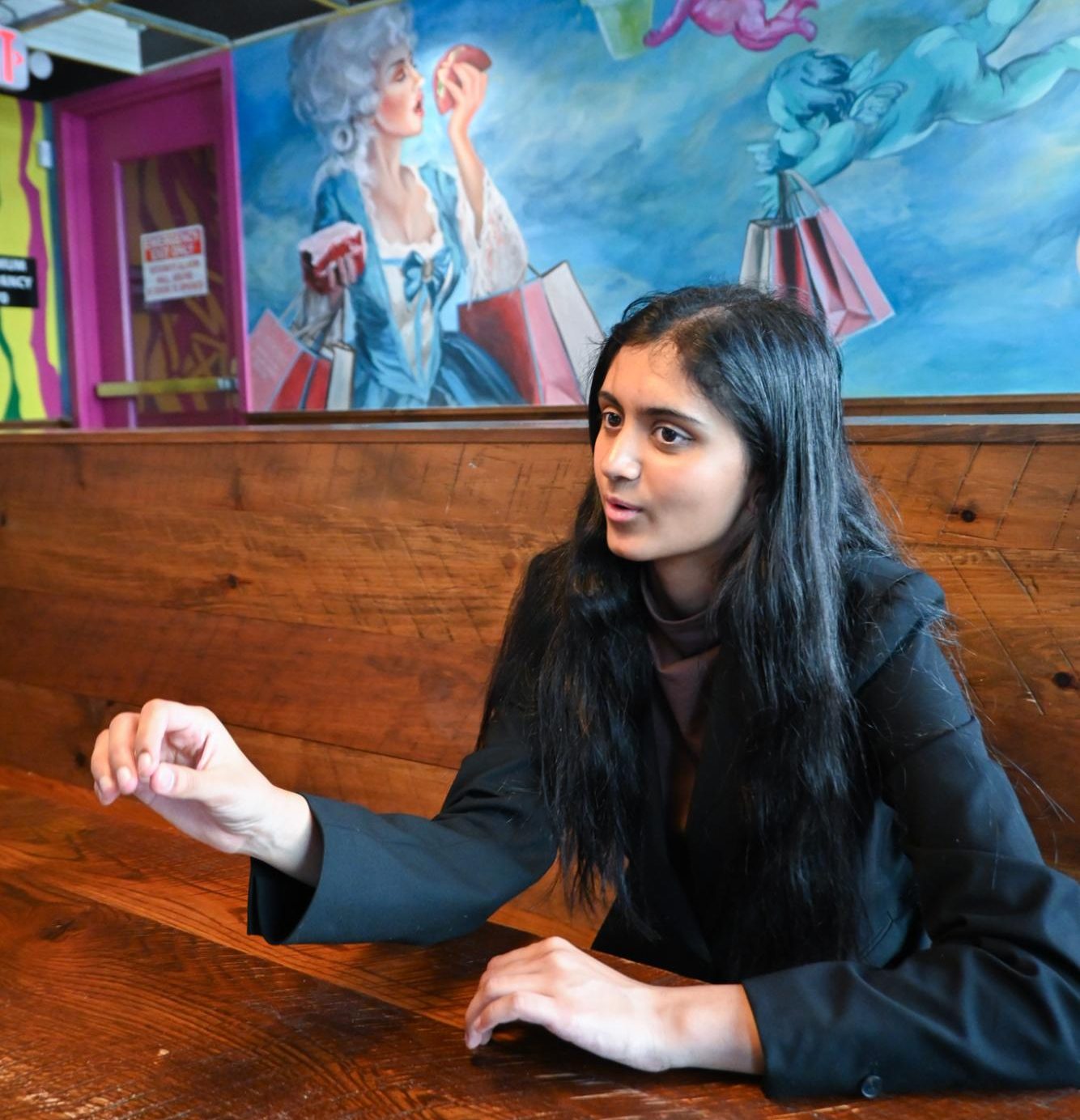
“I did research alongside my parents for the early elections, which I thought was really compelling,” Aanya said. “I remember my dad and I were at a restaurant and he’d ask me what my thoughts were on a certain policy. I really had to think and come up with my own answer, but no matter what I was saying, he [challenged] me to figure out why both sides were wrong or right and then decide again.”
With an early-established foundation encouraging applied critical thinking and an intense focus on analyzing policy, it seemed only natural that Aanya’s broad interest in politics solidified in the form of policymaking.
“I’ve always been more passionate about legislative work than going out and protesting, ” Aanya said. “The whole logic of writing things with precision and trying to minimize [policy] loopholes is really interesting to me.”
Exploring all the possible outlets to manifest her love for policy in high school, Aanya attended the 2025 American Legion Auxiliary Texas Bluebonnet Girls State, a government simulation camp where she authored over a dozen bills.
“Aanya has a unique energy about her that gets other people excited about big, important topics they would otherwise brush aside,” fellow Girls State Citizen Josephine Sun ‘26 said. “[At] Girls State, she was really eager to pass bills and talk about the bills that were being passed, and as a result, I think she encouraged other girls who were [more] scared to pass bills to do it themselves.”
Aanya carved her place in a national network of other dedicated, politically active students. Currently serving as the High School Democrats of America (HSDA) Policy Director and the American Youth Association (AYA) National President, Aanya takes pride in applying her skills to actionable opportunities to enable realtime change.
“In HSDA, I take everyone’s bill ideas and turn them into concrete policies,” Aanya said. “In AYA last year, we had upwards of nine bills in the U.S. Congress, most of which we contributed to in some way, some of which we [even] authored and brought to legislation. This year, we’re trying to break that goal. We have seven bills written so far.”
Locally and most recently, following the 89th Texas Legislature and an eventful special session, Aanya found herself at the Texas Capitol discussing redistricting, education reform, and flood relief measures with state legislators.
“During the special session, we wrote bills on flood relief and I testified against the Texas redistricting efforts. I lobbied bills to over a dozen representatives and discussed the bill replacing STAAR [State of Texas Assessments of Academic Readiness] testing with beginning, middle, and end of year exams,” Aanya said. “Realizing that lawmakers are supposed to benefit normal people like us through the legislative process makes it more important that our voices are heard, and sometimes that has to be done through lobbying to them more personally.”
Her time at the Capitol solidified Aanya’s driving belief that internal improvements in the government were best formed through the legislative process. Bill-writers and lobbiers hold a direct hand in legislation passage, formalizing commitment in a cause that verbally expressing opinions sometimes cannot.
“During the redistricting battle, a lot of young liberal Texans went out and protested, but I felt that didn’t really make an impact [on the outcome],” Aanya said. “When I went to discuss the STAAR test, the coalition I went with was pretty [politically] split, so we just went to discuss the best approach to changing the STAAR. Lawmakers are surprisingly willing to hear the ideas we have. That’s why I think legislative discussions are especially important.”
Yet, Aanya admits, the discussions alone are often not enough, as several bills impacting students went under the radar before being passed, such as the infamous Senate Bill 12 (SB12) banning diversity, equity, and inclusion (DEI) in school clubs, as well as another ban on personal technology usage at school.
“More students should understand policy before it passes and is too late, and we need to leverage our voices as a group,” Aanya said. “Knowing something like the device ban was coming, we should have protested it then.”
Alongside more student involvement in politics, finding powerful representation for minority groups in government and the legislative process is especially important for Aanya, as a woman with an immigrant background.
“When people see that others like them can make it and be involved in politics, it spurs them to consider the possibility [as well],” Aanya said. “There’s a quote I see on [Instagram] Reels all the time that says, ‘how many Einsteins have spent their lives washing dishes?’, referring to the many people out there who have the talent and potential to be really good at governance but haven’t been given the opportunity. Opening access to those opportunities is really important [to me].”
Given the unprecedented nature of many recent education policies affecting Texas schools, Aanya sees it more important than ever for diverse groups of people to stay educated, involved, and outspoken in order to combat legislation they are unhappy with. More than simply expressing personal opinions, taking action to transform beliefs into policy is something Aanya believes more people should do, especially high schoolers.
“Aanya has a really incredible voice and is able to [work with others] in a way where people don’t feel alienated,” Sun said. “As a student and someone who wants other people to be involved in things, Aanya [gives] people a sense that as long as you have your own voice and something you’re passionate about, that’s all you really need in order to make change.”
But, while she works on grand scales writing bills to try and enact change, Aanya remains a high school student, which means searching for ways to work around the complexities of recent bills — both when advocating against them and dealing with their ramifications in real time.
“[Us] students have to figure out how to work around bills like the DEI bill, since there’s no use protesting the bill now that it’s in effect,” Aanya said. “In a sense, we’re all trying to find our own way to work within the system. Doing policy work is just a way I try to more actively figure out what can be done.”